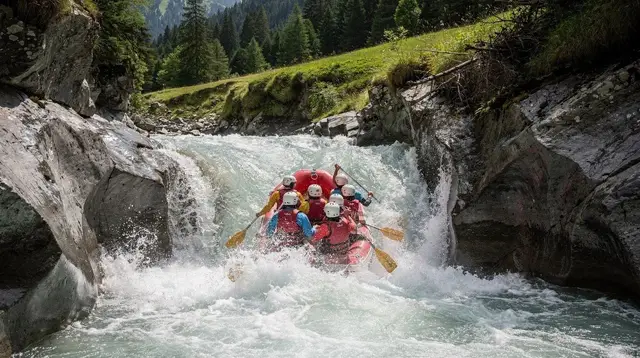
When to Go Rafting in Tyrol: The Real Season
When is the rafting season in Tyrol?
Rafting and canyoning in Tyrol run from June to September, with July and August the most reliable months. The season is set by snowmelt and glacier melt feeding the rivers, not by a fixed calendar, so exact opening dates shift by a few weeks each year and some gorges stay closed into late June.
The rivers have their own calendar, and it isn’t the one visitors expect
Ask when to go skiing around Innsbruck and the answer is straightforward: December to March, give or take the snow. Ask when to go rafting, and the honest answer is a narrower and more weather-sensitive window: roughly June to September, with the middle of that stretch far more reliable than either end. The two seasons don’t overlap, and mixing them up is one of the easiest planning mistakes to make when a trip is being built around Tyrol as a whole rather than around a single valley.
The reason the window is narrow, and the reason it shifts by a couple of weeks every year, is the same reason the water is exciting in the first place: it comes from melting snow and glacier ice high in the mountains, not from a steady managed flow. That single fact explains almost everything a visitor needs to know before booking a date on a river in the Ötztal or anywhere else in the region.
What actually controls the water: snowmelt and glacier melt, not the calendar
Tyrol’s whitewater rivers are glacier- and snowmelt-fed. Through spring, the winter’s snowpack in the high valleys starts to melt as temperatures rise; through summer, glaciers such as those feeding the upper Ötztal and Stubai contribute an additional, temperature-driven flow on top of whatever rain falls. That combination has three practical consequences for anyone planning a trip:
- Water levels swing with the weather, not with the date on a booking form. A hot, sunny stretch accelerates melting and pushes rivers higher and faster within a day or two. A cold snap, or several days of rain replaced by cloud, can bring levels back down just as quickly.
- The season’s opening date moves year to year. In a winter with heavy snowfall and a cool spring, rivers can still be running high and cold well into June. In a lighter winter with an early, warm spring, some stretches can be rafted from late May. Operators set their own opening dates each year based on the conditions they’re actually seeing, not a fixed line on a calendar.
- The season’s closing date is gentler but still real. As autumn arrives and the melt slows down, water levels typically ease off through September, and most operators wind down for the year by the end of that month, well before temperatures make the water genuinely cold and before daylight hours shorten enough to affect the guiding day.
None of this makes rafting unpredictable in a way that ruins a trip. It means the season is solid — June through September is the safe planning window — while the exact conditions on any single day are a live decision the operators make, which is also why this page deliberately doesn’t quote water levels, difficulty grades, or prices: those live on the site-specific pages, where they can be kept current, rather than here.
Month by month, honestly
| Period | What’s typically happening | Rafting and canyoning outlook |
|---|---|---|
| January – March | Ski season across the Olympia SkiWorld area and the glaciers | Rivers are frozen or running very low and cold; no rafting or canyoning operates |
| April – mid-May | Snow still melting at altitude, high valleys often still snowbound | Effectively closed; a handful of lower-altitude stretches may open exceptionally late in the window |
| Late May – mid-June | Melt accelerating, water often high, cold and fast-changing | Season starting to open, but conditions vary sharply; confirm with the operator before travelling |
| Mid-June – August | Peak snowmelt plus active glacier melt, warmest weather | The reliable core of the season, with July and August the most consistent months |
| September | Melt slowing as temperatures drop | Season winding down; calmer water, cooler mornings, most operators still running |
| October – December | Rivers reverting to winter flow, freezing conditions returning | Closed for the year |
This table is the season at a glance. It is not a guarantee that any particular company is running on any particular week — that detail belongs with the operator and with the site-specific guide for wherever you’re headed.
The shoulder-season trap: warm in the valley doesn’t mean open on the river
One of the most repeated planning mistakes across Tyrol applies here just as much as it does to hiking and high cable cars: a warm, sunny day in Innsbruck or in a valley town says very little about what’s happening upstream. It’s entirely possible to have a pleasant 20°C afternoon in the Inn valley in late May while the rivers feeding it are still running cold, high, and un-raftable because the high catchment is only just starting to release its winter snowpack. The same logic that keeps some cable cars and mountain huts closed through the shoulder season keeps some river stretches shut a few weeks longer than a glance at the weather forecast would suggest.
The safest practical rule: treat June as a transition month where a trip built specifically around rafting benefits from checking with the operator close to the date, and treat July through the first half of September as the dependable core of the season. If a rafting day is the centrepiece of a trip rather than one activity among several, booking within that core window removes most of the uncertainty.
Where the water comes from, and where it’s raftable
Tyrol’s best-known whitewater stretch, the Imster Schlucht near Imst, draws its water from the wider Inn and Ötztal catchment and follows the same June-to-September season described here. For the practical detail — how the gorge is graded, what a typical run looks like, and how it compares to gentler family stretches — the dedicated Imster Schlucht rafting guide is the right next stop; this page exists to set the seasonal frame that guide builds on, not to repeat its specifics.
Beginners and mixed groups looking for a first whitewater experience are well served by an introductory run such as a half-day beginner rafting trip on the Imster Canyon, which runs within that same June-to-September window and is one of the more forgiving ways to try the sport. Families travelling with younger children have a gentler, purpose-built option in a rafting tour designed for families with children aged five to ten, which also depends on the same seasonal water conditions rather than running year-round.
For visitors who already know they want more whitewater and less introduction, the difference between rafting and canyoning is worth reading before booking, since the two activities share a season but not much else in terms of what a day actually involves.
Canyoning runs on the same clock
Canyoning in the Ötztal — in gorges such as the Auerklamm and the Alpenrosenklamm — depends on exactly the same snowmelt and glacier-fed water sources as rafting, so it opens and closes on essentially the same calendar. A cold, high gorge can lag a week or two behind a lower rafting stretch simply because its water comes from higher up the mountain, but the broad window is identical: no meaningful canyoning before June, a reliable core through July and August, and a wind-down through September.
Visitors weighing the two activities against each other can start with canyoning for beginners in the Ötztal for an overview of what a first canyoning day involves, and with the dedicated Auerklamm canyoning guide and Alpenrosenklamm canyoning guide for the two specific gorges named on this page. A private, more flexible option for groups who want to set their own pace is a private canyoning tour in the Ötztal valley, again running within the same summer season rather than year-round.
Whichever activity you choose, what to actually bring is worth a look before the day itself — water temperature stays cold even in August, because it’s snow- and glacier-fed regardless of the air temperature above it.
Planning a trip around the water, not the ski season
Because Tyrol is marketed heavily as a ski destination, it’s easy for a first-time visitor to assume the region has one dominant season and build a trip around it. In reality, Tyrol runs on two almost entirely separate calendars that barely touch:
- Winter (roughly December to March): skiing and snowboarding across the Olympia SkiWorld area and the high glaciers, built on snow cover and lift operation.
- Summer (roughly June to September): rafting, canyoning, hiking and high-altitude cable-car sightseeing, built on melted snow, open trails and running rivers.
A trip planned for late spring or early autumn sits in the gap between the two, and while that gap can be a genuinely good time to visit for quieter towns and lower prices, it’s the wrong window to build a rafting-centred itinerary around. If flexibility allows it, shifting a water-sports trip into the June-to-September core avoids the disappointment of arriving to find a gorge still closed or a river still too cold and fast to run safely.
Visitors combining rafting with other summer activities — via ferrata, high hiking on the Stubai Glacier, or a day on the Bikepark Innsbruck trails — will find the same June-onward opening logic applies across most of Tyrol’s outdoor season, for the same underlying reason: snow has to clear the trails, and the glaciers and snowfields have to start their melt, before any of it is reliably open. The things to do: whitewater rafting category page collects the current season’s operators and sites in one place once that window has opened.
A season worth planning around, not against
None of this makes Tyrol’s rafting season a disappointment to work around — quite the opposite. The same snowmelt and glacier feed that narrows the window to four solid months is what makes the water genuinely exciting rather than a tame, managed flow: cold, fast, and different from one week to the next. The practical takeaway for a visitor is simple. Treat rafting and canyoning as firmly June-to-September activities, treat July and August as the two months where conditions are most likely to match expectations, and check with the specific operator — through the Imster Schlucht guide or the equivalent canyoning pages — before locking in a date at either edge of the season.
Frequently asked questions about Tyrol’s rafting season
Can you go rafting in Tyrol in May?
Rarely with confidence. Snowmelt is still building through May, water levels swing sharply day to day, and several operators and access roads to the gorges are not yet running. Most rafting companies open their booking calendars from June.
Is rafting a summer or winter activity in Tyrol?
Summer only. Tyrol has two separate operating calendars: skiing runs roughly December to March on snow and lift infrastructure, while rafting and canyoning run roughly June to September on rivers fed by snowmelt and glacier melt. The two seasons do not overlap.
Why does the water level change so much from week to week?
Alpine rivers in this region are fed largely by melting snow and glacier ice rather than steady rainfall. A hot spell speeds up melting and raises the water; a cold snap or a rainy stretch can lower it again within days, which is why operators check conditions closely rather than publishing one fixed water level for the whole summer.
What is the best month for rafting in Tyrol?
July and August are the most consistent months, with the glacier and snowmelt contribution at its strongest and most predictable, and the highest number of operating days across the season. June can still be turbulent as the melt peaks, and September often brings calmer, lower water as temperatures drop.
Is Imster Schlucht open all year?
No. The Imster Schlucht, one of the best-known whitewater stretches in the Alps, operates on the same summer season as the rest of Tyrol’s rivers, typically from around late May or June through September, depending on that year’s snowmelt. It is not a year-round activity.
Does canyoning follow the same season as rafting?
Yes. Canyoning in gorges such as the Auerklamm and the Alpenrosenklamm depends on the same snowmelt and glacier-fed water sources as rafting, so it opens and closes on roughly the same June-to-September window, with individual sites sometimes starting a little later if they sit higher or closer to a glacier.
Should I plan rafting around a specific date months in advance?
Book a rough week rather than a fixed date if you can, and confirm with the operator closer to travel. Because the season’s edges depend on that year’s snow and heat, an early-June or a mid-September date can go either way, while any date from mid-June to early September is a safe bet.
Whitewater rafting on GetYourGuide
Verified deep-linked GetYourGuide tours. Book through these links and we earn a small commission at no cost to you.
GetYourGuide does not provide a product photo for this activity — the image shows the meeting point, photographed by us.