Rafting vs Canyoning: What's the Difference?
What is the difference between rafting and canyoning near Innsbruck?
Rafting is a group activity on an inflatable raft, paddled together down open whitewater such as the Imster Schlucht. Canyoning is a smaller-group, rope-assisted descent of a narrow gorge on foot and in the water, combining abseiling, jumping and swimming, as run in the Otztal's Auerklamm and Alpenrosenklamm. Both are summer activities and both are always led by a certified guide.
Two Ways to Meet the Same Alpine Water
The valleys around Innsbruck carry a lot of fast-moving summer water, fed by glaciers and snowmelt from the mountains that ring the city. Two activities put visitors directly into that water, and they get confused with each other more often than almost anything else in the region: rafting and canyoning. Both happen mainly west of the city, in the Otztal near Imst, and both are strictly summer activities run by certified guides. Beyond that, they are genuinely different experiences, with different equipment, different group dynamics and different demands on a participant’s body and nerve.
This page does not review a specific rafting or canyoning operator or route in detail — that is what the individual guides to the Imster Schlucht, the Auerklamm and the Alpenrosenklamm are for. What follows is the comparison itself: what each activity actually involves, how they differ in practice, and which questions to ask yourself before choosing one over the other.
Rafting: A Group Descent on an Inflatable Raft
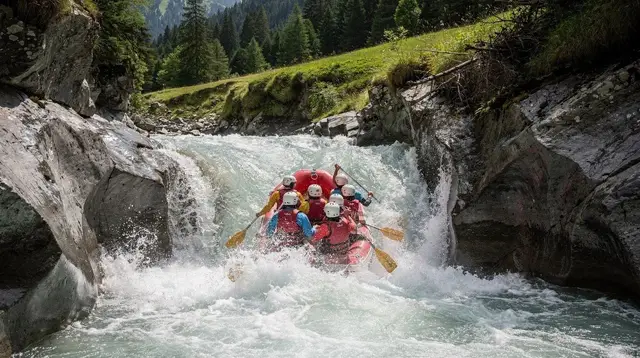
Whitewater rafting near Innsbruck happens almost entirely on the Imster Schlucht, one of the best-known whitewater stretches in the Alps and the reason the activity is associated with this corner of Tyrol at all. A rafting trip puts a group of paddlers — usually six to eight people plus a guide — into one large inflatable raft. The guide sits at the back, steers with a paddle and calls the instructions, while everyone else paddles together to power the raft through rapids, around rocks and along calmer stretches in between.
The physical demand is real but shared. Nobody swims the river on a standard rafting trip; the boat does the work of staying afloat, and the main job of a participant is to paddle on command and hold on through the rougher sections. Falling out of the raft briefly is a normal, anticipated part of bigger rapids, which is why everyone wears a personal flotation device and a helmet throughout, and why guides brief the group on what to do if it happens before the raft ever touches the water.
Rafting suits people who want a big-water adrenaline hit without needing rope skills, without abseiling, and without having to be a strong swimmer in the way canyoning demands. It is also inherently more social: a full raft moves and reacts as one unit, and the shared effort of paddling through a rapid together is part of the appeal.
Family-oriented and gentler sections exist alongside the more technical whitewater, and the family rafting guide for the Otztal covers who those softer trips suit. For the mechanics of a typical Imster Schlucht descent, current operating patterns and what a rafting day looks like start to finish, the Imster Schlucht rafting guide is the page to read next.
Canyoning: Descending a Gorge on Foot, by Rope and by Water
Canyoning is a different sport built around a different landscape feature: a narrow mountain gorge, or Klamm, cut by a stream over centuries into rock. Rather than sitting in a raft and paddling downstream, a canyoning group works its way down through the gorge itself — walking where the ground allows it, abseiling down small waterfalls on a rope fixed by the guide, jumping from ledges into deep pools, and sliding down smooth, water-polished rock chutes. It is a slower, more technical, more intimate encounter with moving water than rafting, and a solitary one in a sense: even inside a group, each person makes their own abseil, their own jump, their own swim across a pool.
Every participant wears a wetsuit, a helmet and a harness, and the guide sets and checks every rope anchor, briefs each obstacle before it happens, and can adjust the route around any section that looks unsafe on the day.
Two gorges in the Otztal are the region’s standard settings: the Auerklamm, generally the more approachable of the two and a common choice for a first canyoning experience, and the Alpenrosenklamm, which tends to ask more in terms of fitness, comfort with height and comfort in moving water. Neither gorge is a place to go without a guide: reading the safe line down a canyon, judging water levels and managing the ropework are not skills a visitor is expected to bring.
Because canyoning involves sustained swimming, repeated cold-water immersion and jumps of a few metres into pools, it generally asks more of a participant than rafting does, even though the guide manages every technical step. For anyone weighing up a first canyoning trip specifically, the beginner’s guide to Otztal canyoning sets out what a first descent actually feels like and what fitness or confidence level it assumes.
Rafting and Canyoning Side by Side
| Rafting | Canyoning | |
|---|---|---|
| Setting | Open whitewater river, mainly the Imster Schlucht | Narrow rock gorge, mainly the Auerklamm and Alpenrosenklamm |
| How you move | Together, paddling one shared raft | Individually, on foot, by rope and by swimming |
| Group feel | Whole-boat teamwork | Same group, but each person does their own obstacle |
| Rope work | None | Abseiling set and checked by the guide throughout |
| Water contact | Mostly seated in the raft, occasional splashes or a fall-in | Continuous — swimming, jumping, sliding through pools |
| Equipment worn | Personal flotation device, helmet, paddle | Wetsuit, helmet, harness |
| Typical intensity range | Family-friendly sections through to bigger whitewater | Beginner-friendly gorge through to more technical gorge |
| Season | Summer, snowmelt-dependent | Summer, snowmelt-dependent |
| Guiding | Always guided | Always guided, with rope safety managed by the guide |
| Pricing | See the specific tour or operator | See the specific tour or operator |
Which One Fits You
If the appeal is the idea of a big raft crashing through whitewater with a group of people paddling in rhythm, and less enthusiasm for jumping off ledges or swimming through cold pools alone, rafting on the Imster Schlucht is the more natural fit. It also tends to suit a wider age range and a broader spread of swimming ability, within the limits each operator sets for a given trip.
If the appeal is closer to an adventure sport — working through a gorge obstacle by obstacle, abseiling down a small waterfall, jumping into a clear pool below it — canyoning in the Auerklamm or the Alpenrosenklamm is the better match. It rewards comfort with heights, confident swimming and a willingness to be cold and wet for a sustained stretch, in exchange for a much more immersive, physically engaged few hours.
Plenty of visitors do both on the same trip to the Otztal, on separate days, precisely because the two activities do not compete with each other so much as complement each other: one is a shared ride on the water’s surface, the other a hands-on descent through it.
Season and Timing: Summer Only, Always With a Guide
Both activities depend on the same seasonal fact: the water in these rivers and gorges comes largely from snowmelt and glacier melt higher up the Otztal, so both rafting and canyoning run in the warmer months, not through winter and not reliably through the coldest edges of spring or autumn. Exact opening and closing dates shift from year to year with snow conditions and water levels, and the rafting season guide sets out how that typically plays out across a summer.
Neither activity is something to attempt independently, at any time of year. Reading a fast river or a technical gorge correctly, judging current water levels, setting safe rope anchors and knowing when conditions are too dangerous to run a route at all are jobs for a certified guide, not a visitor working from a guidebook. Every legitimate operator in the Otztal runs both rafting and canyoning as guided trips only, and that is the basis on which this whole comparison is written.
Booking Rafting and Canyoning From Innsbruck
Both activities are usually booked as a half-day or day trip out of Innsbruck, with transport to the Otztal typically included in the tour. On the rafting side, options range from a family-friendly float to bigger whitewater: a straightforward option is a guided whitewater rafting trip on the Otztal’s rivers, while a more specific route runs as a full rafting descent through the Imster Schlucht itself, and a further variant is sold as a half-day whitewater rafting experience based near Haiming.
On the canyoning side, routes are also graded by intensity: a gentler introduction is available as a clear-water canyoning tour aimed at first-time participants, while a more demanding version, with bigger jumps and longer stretches of moving water, is booked as a more intense canyoning descent for confident swimmers. Whichever route or intensity you pick, check the specific tour’s minimum age, fitness expectations and current price directly on its booking page, since none of that is fixed enough across a season to state reliably here.
For a wider look at how to structure a day or two around either activity, the Otztal and Imster Schlucht whitewater itinerary sets out a practical plan, and the things to do: whitewater rafting and things to do: canyoning and gorges category pages list the fuller range of bookable options across both activities. The Otztal things-to-do overview is the place to see everything the valley offers alongside its whitewater.
What to Bring
Wetsuits, helmets and harnesses for canyoning, and flotation devices, helmets and paddles for rafting, are supplied by the operator on both activities, so the packing question is really about everything around the technical kit: swimwear to wear underneath a wetsuit, a towel and dry clothes for afterwards, secure footwear that can get wet, and a plan for what happens to your phone, wallet and car keys while you are on the water. The packing guide for rafting in Tyrol goes through this in more detail and applies just as well to a canyoning day.
Rafting or Canyoning in the Otztal: Your Questions Answered
Is rafting or canyoning more extreme?
Canyoning generally asks more of a participant physically and mentally, since it mixes abseiling, jumping into pools and swimming through moving water inside a narrow gorge. Rafting keeps the whole group together on one raft and is steered by the guide, so the physical demand is lower and more evenly shared, though rougher rafting sections still deliver a strong adrenaline hit.
Can beginners do canyoning, or is it only for experienced people?
Beginners are the normal audience for an introductory canyoning route such as the Auerklamm, which is designed and guided for first-timers. More technical gorges such as the Alpenrosenklamm ask for a reasonable level of fitness and comfort in water, so check the specific route’s guide before booking rather than assuming one canyon suits everyone.
Do I need to know how to swim for rafting or canyoning?
Yes, for both. Canyoning in particular involves sustained swimming through pools inside the gorge, so a confident, basic swimming ability is a standard prerequisite. Rafting requires less continuous swimming, but everyone wears a personal flotation device and must be able to cope in water if the raft empties briefly.
What is the Imster Schlucht and why does it come up for rafting?
The Imster Schlucht is one of the best-known whitewater stretches in the Alps and the main setting for group rafting trips run from the Otztal area. It is covered in full, including how a typical descent runs, on the dedicated Imster Schlucht rafting guide rather than on this comparison page.
Which is better for a family with children?
Family-oriented options exist on both sides, including gentler rafting sections and a children’s canyoning format aimed at younger participants, but age and height minimums vary by operator and by water level in a given season. The family-focused Otztal rafting guide and the individual canyon guides are the right place to check current suitability before booking.
Are rafting and canyoning available all year in the Otztal?
No. Both depend on summer meltwater and warm-enough conditions, so they run in the warmer months rather than through winter or the shoulder seasons. See the rafting season guide for how that window typically falls.
Can I go rafting or canyoning without a guide?
No responsible operator in the Otztal offers unguided rafting or canyoning, and this page assumes a certified guide leads every descent. Both activities involve rope work, reading fast water and gorge-specific hazards that require professional judgment, not a self-guided outing.
What should I bring for a rafting or canyoning day?
Operators supply the technical equipment — wetsuit, helmet and, for rafting, the paddle and personal flotation device — but you still need to plan clothing, footwear and what to do with your belongings for the day. The dedicated packing guide covers this in detail so it is not repeated here.
Whitewater rafting on GetYourGuide
Verified deep-linked GetYourGuide tours. Book through these links and we earn a small commission at no cost to you.
GetYourGuide does not provide a product photo for this activity — the image shows the meeting point, photographed by us.