Family Rafting in the Ötztal: What to Actually Expect
Is there family-friendly rafting in the Ötztal, less intense than the Imster Schlucht?
Most rafting sold under the Ötztal name actually runs on the Imster Schlucht, a stretch that operators grade for different experience levels rather than offering a separate, gentler Ötztal river section. If you're travelling with children, confirm minimum age, swimming ability, and the trip's grading directly with the operator before booking, since this can vary by water level and by season.
The honest answer before you book anything
Search for family rafting in the Ötztal and you’ll find plenty of tour listings using the word “Ötztal” in their name. What’s less obvious from a listing page is where the boat actually goes, and whether the trip is genuinely suitable for a family with children. This guide exists to answer that question as carefully as the facts allow, rather than to invent a gentler Ötztal-specific river section that doesn’t appear in any operator’s route description.
The short version: the rafting products sold as “Ötztal” trips generally run on the Imster Schlucht, a well-known whitewater stretch just outside the valley, near Imst. There isn’t a separately documented, easier river section inside the Ötztal proper that’s marketed specifically as a family run. That doesn’t mean nothing suitable exists — operators grade the same stretch differently depending on the trip, the season, and the water level — but it does mean the responsible approach is to ask the operator directly rather than to assume a softer version exists just because a tour is labelled “Ötztal.”
Why “Ötztal rafting” usually means the Imster Schlucht
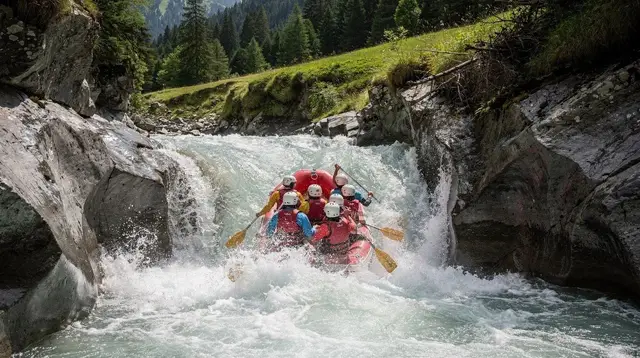
The Ötztal is a long alpine valley running south from the Inn near Ötztal-Bahnhof up toward Sölden and the glacier. Its own rivers and side streams feed the wider whitewater scene in this part of Tyrol, but the section most commonly rafted, and the one operators actually put groups on, is the Imster Schlucht — a canyon-like stretch of the Inn/Pitze system near Imst that has become one of the best-known whitewater runs in the Alps.
Rafting companies based in and around the Ötztal run trips there, which is why you’ll see products described as “Ötztal: Rafting Tour in the Imster Gorge” even though the water itself is at the Imster Schlucht rather than inside the Ötztal valley. This is a genuinely useful thing to understand before booking: it tells you that researching “family rafting near the Ötztal” and researching the Imster Schlucht are, in practice, largely the same research project. For the technical detail on that stretch — put-in points, how it’s graded, and what a typical run involves — the dedicated guide is the better read; this page focuses specifically on the family angle and what to check before you commit.
If you want the calmer or more technical activity to be genuinely separate from rafting, that’s canyoning, covered next.
Rafting is not canyoning, and neither is a substitute for the other
Two very different water activities get grouped together loosely under “Ötztal adventure sports,” and it’s worth being precise about which one you’re booking.
Rafting puts a group of six to eight people in an inflatable boat with a guide steering from the back, moving downstream through rapids together. Everyone stays in the boat as a team; it’s a shared, sociable activity, and grading depends on the water level and the specific stretch run.
Canyoning is a solo-through-a-team activity where each person, in a wetsuit and helmet, descends a narrow gorge by abseiling down waterfalls, sliding down natural rock chutes, and jumping into plunge pools. The Ötztal’s two well-known canyoning gorges, the Auerklamm and the Alpenrosenklamm, are genuinely committing activities with their own fitness and confidence requirements — not a gentler alternative to rafting, and not something to book instead of rafting for a nervous swimmer or a young child.
If you’re trying to decide which of the two fits your group, the rafting versus canyoning comparison lays out the practical differences — what each one physically involves, roughly how fit or confident in water you need to be, and which one suits which kind of traveller. For a from-scratch introduction to canyoning as its own activity, see the beginner’s guide to Ötztal canyoning; both of the valley’s gorges also sit in the canyoning and gorges category if you want to browse the full set of options rather than pick a single guide.
This page deliberately doesn’t go deep into either the Imster Schlucht itself or Ötztal canyoning — both have their own dedicated coverage — but it’s worth being clear about the boundary so you don’t end up booking a canyoning trip for a six-year-old by mistake, or a rafting trip expecting the sedate pace of a canyon walk.
What to check with the operator before booking for a family
Because there isn’t a single standardised “family rafting” product across every operator in this area, the practical approach is to treat the following as a checklist for whatever specific trip you’re looking at, rather than to assume any one tour automatically qualifies as family-friendly.
| What to ask | Why it matters |
|---|---|
| Minimum age for this specific trip | Varies by operator and can change with water level; some trips exclude young children outright |
| Whether the trip includes swimming or jumping into the water | Some rafting trips involve optional swims in calmer stretches; not every child (or adult) wants this |
| Current water level and how it affects grading | The same stretch can feel noticeably calmer or rougher depending on recent rain and snowmelt |
| Whether wetsuits, helmets, and buoyancy aids are provided and fitted for smaller sizes | Comfort and safety depend on genuinely well-fitting gear, not just any spare wetsuit |
| Group size and pace of the specific departure | A trip run for a mixed group of adventure travellers moves differently from one run for families |
| What happens if a child is uncomfortable partway through | Ask whether there’s an exit point partway along the run, since rafting trips don’t always allow a mid-river pull-out |
None of these questions require special knowledge — they’re the same ones a careful parent would ask about any water-based activity — but asking them of the specific operator and specific departure, rather than trusting a listing’s use of the word “family,” is the honest way to plan this.
Two rafting products worth comparing side by side when you do this research:
a half-day rafting run through the Imster Gorge is the standard format most operators offer, while a longer version of the same run that includes a lunch stop suits a group that wants to make more of a day of it. Both are worth checking against the questions above rather than assumed to be interchangeable — the pace, group size, and exact route can differ between listings even on the same stretch of water.
When this is even possible: it’s a summer activity
Rafting on alpine rivers in this region runs during the warmer months only, roughly from late spring into early autumn, driven by snowmelt and manageable water temperatures rather than a fixed calendar date. It is not available outside that window, and specific opening and closing dates shift from year to year depending on the winter’s snowpack and how quickly it melts. If you’re planning a trip for a shoulder-season date, or for winter, treat rafting as off the table and check the rafting season guide for how that window is currently looking before you build a day around it.
This seasonal limit is one of the easiest details to get wrong when planning from a distance — a listing found in December doesn’t tell you whether the river will be running when you actually travel in March. Confirming current dates with the operator, close to your travel dates, is the only reliable way to know.
If rafting doesn’t suit the whole family, two real alternatives nearby
Not every family wants whitewater, and that’s a reasonable call to make rather than something to talk yourself out of. Two genuinely different water-based activities sit close to the Ötztal and don’t involve river rapids at all.
AREA 47’s water park attractions, at the mouth of the Ötztal, include controlled, structured water activities alongside its other adventure sports, and they’re a reasonable way to give children a water-based day out without putting them in a raft on a live river. It’s worth checking current age and height requirements for individual attractions there too, since these are set per activity rather than park-wide.
For a calmer, warm-water option, especially with younger children or on a day when the weather doesn’t cooperate, a day at the AQUA DOME thermal spa in Längenfeld offers indoor and outdoor thermal pools rather than moving water. It sits within the Ötztal itself, so it pairs naturally with a day exploring the valley without adding a second long drive.
The AREA 47 family guide and the AQUA DOME guide for Längenfeld go into more detail on what each place actually involves, timing, and what to bring.
Getting there and practical basics
The Ötztal is reached by road or rail from Innsbruck via Ötztal-Bahnhof, with local buses running up the valley toward Sölden and the side valleys. Rafting operators based in the area typically include pickup from accommodation in and around the valley, and sometimes from Imst directly, as part of the booking — worth confirming when you book rather than assuming, since pickup radius varies by company.
If you’re combining a rafting day with other Ötztal activities, the things to do in the Ötztal overview groups the valley’s main activities by type, and the whitewater rafting category lists the rafting-specific options across the wider area rather than a single valley. For a structured multi-day plan that includes a whitewater day alongside gentler activities, the Ötztal and Imster Schlucht whitewater itinerary sketches out how a family or mixed group might sequence a few days here.
One last honest note, since it comes up often enough to be worth heading off directly: the Ötztal takes its name partly from its association with Ötzi the Iceman, the 5,300-year-old mummy discovered in 1991. He was found on the Tisenjoch, on the Italian side of the border in these same mountains, and he’s displayed today in the South Tyrol Museum of Archaeology in Bolzano, Italy — not anywhere in the Austrian Ötztal. If seeing the mummy is part of your trip plan, that’s a Bolzano day, not an Ötztal one; the piece on where Ötzi was actually found explains the mix-up in more detail.
Family rafting in the Ötztal: your questions answered
Is there a specific rafting river inside the Ötztal valley itself, separate from the Imster Schlucht?
The rafting trips marketed as Ötztal rafting typically operate on the Imster Schlucht, just outside the valley near Imst, rather than on a dedicated in-valley Ötztal stretch. Confirm the exact put-in and route with the operator when you book.
What’s the minimum age for family rafting trips from the Ötztal?
Minimum ages are set by each operator and can depend on water level and trip grading, so there is no single valley-wide rule. Ask the operator directly before booking if you’re travelling with children.
When can you go rafting near the Ötztal?
Rafting in this area runs in the warmer months, roughly from late spring to early autumn, and depends on snowmelt and water levels. It is not a year-round activity, so check current dates with the operator before planning your trip.
Is canyoning in the Auerklamm or Alpenrosenklamm a good family alternative to rafting?
No — canyoning in the Ötztal’s gorges is a more committing, technical activity involving jumps, abseils, and cold water, and it isn’t a gentler substitute for rafting. It has its own age and fitness requirements, which are covered on its own guide rather than here.
Can you see Ötzi the Iceman if you visit the Ötztal?
No. Ötzi was found on the Italian side of the Ötztal Alps, at the Tisenjoch, and is displayed in Bolzano, Italy — not anywhere in the Austrian Ötztal valley.
What are calmer alternatives to whitewater rafting for younger children in this area?
AREA 47’s controlled water activities and the AQUA DOME thermal spa at Längenfeld both offer water-based fun without whitewater, and are worth considering for families with younger or more nervous children.
Does the Innsbruck Card cover rafting trips in the Ötztal?
No, rafting trips are commercial activities run by private operators and are booked and paid separately; the Innsbruck Card covers public transport, cable cars, and museum admissions instead.
Whitewater rafting on GetYourGuide
Verified deep-linked GetYourGuide tours. Book through these links and we earn a small commission at no cost to you.
GetYourGuide does not provide a product photo for this activity — the image shows the meeting point, photographed by us.