Alpenrosenklamm Canyoning in Sautens, Ötztal
Where is the Alpenrosenklamm, and how does it relate to Sautens?
The Alpenrosenklamm is a narrow gorge in the Ötztal, treated locally as the valley's second major canyoning site after the Auerklamm, and it is reached from the village of Sautens. It runs as a summer activity only. No independent pricing, descent duration or technical figures such as jump or rappel counts are verified here — confirm those directly with a local canyoning guide office before booking.
A Second Gorge Beside the Auerklamm
Ask anyone who guides canyoning trips in the Ötztal which gorge comes up first, and the answer is usually the Auerklamm. Ask what comes second, and the Alpenrosenklamm is the name that follows. It is not a lesser-known secret so much as the valley’s other established canyoning venue — a separate cut in the rock, a separate stretch of moving glacial meltwater, and a separate booking line on most local operators’ summer programmes, sitting alongside rather than inside the same system as the Auerklamm.
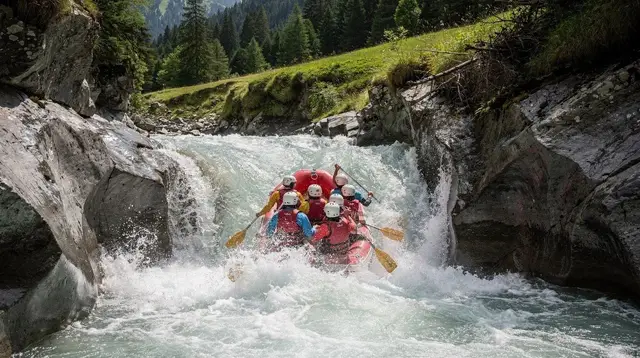
The two gorges get compared constantly, and it is worth being precise about why. Canyoning as an activity is really a family of routes rather than one fixed experience: a group descends a gorge on foot and by rope, moving with the water rather than around it, through a sequence of pools, narrow passages, small waterfalls and rock steps, wearing a wetsuit and a climbing harness and following a certified guide the entire way. The Auerklamm and the Alpenrosenklamm both deliver that experience in the Ötztal, in the same general season, often through the same handful of local guide offices — but they are physically different gorges, in different parts of the valley, and a tour booked into one does not run through the other.
This page covers the Alpenrosenklamm specifically: where it sits, what village anchors it, how it is normally talked about alongside the Auerklamm, and — just as importantly — what this site does not claim to know about it. No length, no jump count, no rappel count and no fixed price for the Alpenrosenklamm appears anywhere on this page, because none of those figures has been independently verified for this specific gorge. Canyon routes get re-cut, re-bolted and re-rated by operators from one season to the next in response to water levels and safety audits, and a number printed here that goes stale is worse than no number at all. Where a figure matters, the honest answer is to check with the guide office that runs the tour.
Sautens: The Village at the Foot of the Gorge
The place name that attaches to the Alpenrosenklamm, consistently, is Sautens. It is a small village on the lower stretch of the Ötztal road, on the way in from the Inn valley before the valley narrows and climbs toward Ötztal-Bahnhof and eventually Sölden. Sautens is not a resort in its own right — there is no lift network, no strip of hotels built around a slope — and most visitors either pass through it on the drive up the valley or stop specifically because a canyoning tour starting point is based nearby.
That makes Sautens more of an access point than a destination to build a whole day around. If your plan is Alpenrosenklamm canyoning, the practical pattern is straightforward: get yourself, or be picked up, at or near Sautens for the meeting time your guide office gives you, spend the guided session in and around the gorge, and then continue on with the rest of the day — either back down toward Innsbruck or on up the valley toward Ötztal villages further from the Inn.
Because Sautens itself is modest, most people staying overnight in the region choose a base further up the valley — around Ötztal-Bahnhof, Umhausen or toward Sölden — and treat a Sautens canyoning tour as a single day’s excursion rather than the centre of a multi-day stay. That is a reasonable way to plan it: the gorge and the village around it are worth an outing, not a base.
What Canyoning at the Alpenrosenklamm Actually Involves
At the level of general practice — not specific to this one gorge, and not a substitute for your guide’s own briefing — canyoning in the Ötztal follows a fairly consistent shape. A local operator fits each participant with a wetsuit, a helmet, a climbing harness and, often, a life jacket for the deeper pools, then briefs the group on the route before setting off. The descent itself alternates between walking, wading, swimming and short abseils down wet rock, moving downstream through the gorge under the guide’s direction rather than at each person’s own pace. Groups are typically kept small, both for safety and so the guide can watch everyone at once in a confined, echoing space where shouted instructions do not always carry.
What distinguishes one gorge from another, in practice, is the character of the rock and the water more than the equipment or the format: how narrow the passages are, how many pools invite a jump rather than a climb-down, how cold and how fast the meltwater is running on a given day. Those details shift with the season and even with the week, which is exactly why this page will not assign the Alpenrosenklamm a fixed difficulty grade or a fixed list of features. A guide office running tours there through the summer is watching current water levels in a way a static page cannot, and their briefing on the day is the accurate version.
Two of the touring options that cover Ötztal canyoning at a beginner-friendly level are worth naming here, since they describe the kind of format the Alpenrosenklamm is generally booked through rather than a specialised extreme-sports variant:
a beginner-oriented canyoning session built around the Alpenrosenklamm itself, and, for anyone weighing up options across the valley more broadly, a general Ötztal canyoning tour pitched at first-timers. Families travelling with younger children may also want to ask a guide office directly about a children’s canyoning format rather than assuming the standard adult route will suit every age.
Alpenrosenklamm, Auerklamm and Imster Schlucht: Not the Same Thing
Because the Ötztal packs several water-based activities into a fairly short stretch of valley, it is easy to blur the Alpenrosenklamm together with its neighbours. They are not interchangeable, and mixing them up when you book is the single most common way to end up in the wrong vehicle on the wrong morning.
| Site | What it is | Typical format | Season |
|---|---|---|---|
| Alpenrosenklamm | A gorge near Sautens | Guided canyoning descent | Summer months |
| Auerklamm | A separate Ötztal gorge | Guided canyoning descent | Summer months |
| Imster Schlucht | A whitewater river gorge near Imst | Guided rafting | Summer months |
The Auerklamm is covered on its own page — see the Auerklamm canyoning guide — and this page does not attempt to describe that gorge’s route in detail. The Imster Schlucht is a different activity entirely: it is a whitewater river stretch run by raft rather than a narrow gorge descended on foot and by rope, and it sits in a different part of the region, closer to Imst than to Sautens.
If you are trying to decide between a day of canyoning and a day of rafting, the comparison worth reading is rafting versus canyoning: what’s the difference, and a rafting-specific packing question is answered separately in what to bring rafting in Tyrol. For the Imster Schlucht itself, the dedicated page is the Imster Schlucht rafting guide.
For a broader look at general Ötztal canyoning options and how beginner tours across the valley are typically structured, the Ötztal canyoning for beginners guide is a useful starting point before narrowing down to a specific gorge.
Season and Conditions
Canyoning through Alpine gorges like the Alpenrosenklamm is a warm-season activity, running through the summer months when meltwater levels, air temperature and daylight make a guided descent practical and safe. Exact opening dates move from year to year depending on snowpack and spring runoff, and a wet or unusually cold stretch can pause tours on short notice — a normal feature of any activity that depends on a mountain river rather than a weather forecast a month out.
That variability is exactly why this page does not print specific opening and closing dates, descent durations or difficulty ratings for the Alpenrosenklamm: none of those figures has been independently verified here, and a stale number is worse than none. The reliable way to plan around season is to contact a local canyoning guide office directly in the weeks before your trip and ask what is currently running. For a wider view of how the Ötztal’s activity calendar shifts across the year, when to hike in Tyrol: a season guide covers the same broad shoulder-season logic that applies to canyoning as well as trail walking.
Getting There from Innsbruck
Sautens sits in the lower Ötztal, which branches south-west off the Inn valley a short way west of Innsbruck. By car, the route follows the motorway and then the valley road up from the Inn, passing Haiming before reaching Sautens; by train, the Inn valley line runs to Ötztal-Bahnhof, from which onward travel into the valley is by bus or transfer. Because canyoning tours run on a fixed group schedule with equipment fitting at the start, arriving with margin rather than cutting it close matters more here than for a self-paced hike.
Many local canyoning operators build pickup from nearby villages, or even from Innsbruck itself, into the booking, which removes the need to arrange your own transfer on the day — worth asking about specifically when you reserve a tour, since it is not always advertised up front. If you are combining an Alpenrosenklamm morning with other activity further into the valley, the Ötztal destination page lays out the wider valley’s geography, and Sölden, further up, is a common next stop for anyone extending the day.
Booking Through a Local Guide Office
Because canyoning is a guided activity requiring certified instruction and safety equipment, the practical way to book the Alpenrosenklamm is through one of the local operators running tours there through the season, rather than by turning up at the gorge independently. A handful of bookable options that cover Alpenrosenklamm and general Ötztal beginner canyoning are listed above through this site’s affiliate partners, and contacting the operator directly ahead of a trip is the right way to confirm current pricing, group timing, minimum age and physical requirements — figures this page deliberately leaves to them rather than estimating.
If your group includes a genuine beginner nervous about a first canyoning trip, saying so when you book is worth doing plainly: operators running an entry-level canyoning experience in the Ötztal generally pitch the pace and route selection to match a first-timer group, rather than assuming everyone booked in has done it before.
Beyond the Gorge: Other Things To Do Near Sautens
A canyoning morning at the Alpenrosenklamm leaves most of a day free, and the lower Ötztal and surrounding valley offer plenty to fill it without doubling back into another gorge. Anyone travelling with a mixed group, or simply wanting a change of pace after a wet morning in a canyon, has several nearby options worth considering.
The AQUA DOME thermal spa at Längenfeld, further up the valley, is a natural way to warm up after a cold-water morning, and the practical question of whether it is worth the detour is addressed directly in is the AQUA DOME worth it: price and tips. Families with energetic kids sometimes prefer to pair canyoning with a visit to AREA 47, the valley’s outdoor adventure park.
For a broader sense of what else the region offers beyond water activities, the things to do in the Ötztal category page rounds up the valley’s options, and the canyoning and gorges category lists other guided gorge experiences across the wider Innsbruck region for anyone who wants to compare more than one canyon before deciding.
One geographic point is worth restating plainly because it trips visitors up more than any other fact about this valley: the Ötztal is named after Ötzi, the prehistoric mummy discovered in the mountains above it in 1991 — but Ötzi himself was found on the Italian side of the Alpine watershed and has been on permanent display in Bolzano, Italy, ever since. Sautens has no Ötzi exhibit, and neither does anywhere else in the Austrian Ötztal; the fuller story of why the discovery site and the display site ended up in two different countries is told in Ötzi was found in Italy, not Tyrol.
Frequently Asked Questions About Alpenrosenklamm Canyoning Near Sautens
Where exactly is the Alpenrosenklamm?
The Alpenrosenklamm is a gorge in the Ötztal, the valley that runs south-west from the Inn near Haiming and Ötztal-Bahnhof toward Sölden. It sits near the village of Sautens, on the lower stretch of the valley, and is reached by road from Sautens rather than from deeper in the Ötztal.
Is the Alpenrosenklamm the same as the Auerklamm?
No. The Auerklamm and the Alpenrosenklamm are two separate gorges, and both are genuine Ötztal canyoning destinations. Locally the Auerklamm is usually treated as the valley’s flagship canyon, with the Alpenrosenklamm running alongside it as a second option near Sautens rather than a substitute route through the same gorge.
Can I do the Alpenrosenklamm without a guide?
Canyoning at the Alpenrosenklamm is a guided activity. It involves wading, jumping, abseiling and swimming through moving glacial meltwater inside a confined gorge, and it is organised through licensed local canyoning outfitters who supply the wetsuits, harnesses and safety equipment and set the group up with a qualified guide. It is not a route to attempt independently.
What is the closest village to the Alpenrosenklamm?
Sautens is the village most closely associated with the Alpenrosenklamm, sitting on the lower Ötztal road not far from Haiming and the Inn valley. It is a small base rather than a resort, so most visitors either drive in for the canyoning tour itself or stay further up the valley, in Ötztal-Bahnhof, Umhausen or beyond, and travel down to Sautens for the day.
Can I see Ötzi near Sautens or in the Ötztal?
No. Ötzi, the prehistoric mummy the valley is named after, was found in 1991 at the Tisenjoch on the Italian side of the Alpine watershed, not in Austria, and is on permanent display at the South Tyrol Museum of Archaeology in Bolzano, Italy. The Ötztal in Tyrol has exhibits and trail markers referencing the discovery, but the mummy itself is not, and has never been, on show in Sautens or anywhere else in the Austrian Ötztal.
When is the Alpenrosenklamm canyoning season?
Canyoning at the Alpenrosenklamm runs in the warmer months, broadly matching the rest of the Ötztal’s canyoning season, when meltwater levels and daylight make the gorge workable. Exact opening and closing dates shift year to year with snowmelt and water levels, so confirm current availability with a local guide office before planning a specific date.
Is Alpenrosenklamm canyoning suitable for beginners?
Beginner-oriented canyoning tours are a normal part of the Ötztal’s offering, including options built around gentler introductory routes and family or children’s formats. Whether a specific Alpenrosenklamm tour suits a first-timer, a child or a more experienced canyoner depends on the operator and the exact route on the day, so it is worth stating your experience level when you book.
How do I get from Innsbruck to Sautens?
Sautens is in the lower Ötztal, reached from Innsbruck by driving or taking the train along the Inn valley toward Ötztal-Bahnhof and then continuing up the valley road, or by regional bus. Most canyoning operators offering Alpenrosenklamm tours also arrange pickup from nearby Ötztal villages or from Innsbruck itself as part of the booking — worth asking about when you reserve.
Canyoning and gorges on GetYourGuide
Verified deep-linked GetYourGuide tours. Book through these links and we earn a small commission at no cost to you.
GetYourGuide does not provide a product photo for this activity — the image shows the meeting point, photographed by us.