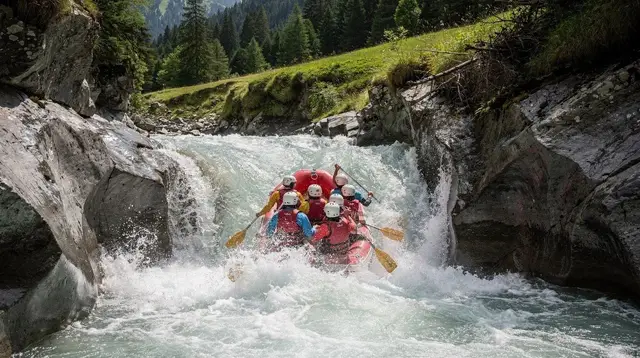
Imster Schlucht Rafting Guide
Where do you go rafting near Innsbruck, and why is the Imster Schlucht well known?
The Imster Schlucht, a gorge on the Inn river near Imst about 45 minutes west of Innsbruck, is one of the best-known whitewater rafting stretches in the Alps. It runs as a summer activity, with water levels and the operating season shaped by snowmelt rather than a fixed calendar, so it is not available year-round.
Where the Whitewater Runs West of Innsbruck
Ask a local outdoor guide in Tyrol where to go rafting and the answer, more often than not, points west of Innsbruck to the Imster Schlucht, a gorge the Inn river has carved near the town of Imst. It is one of the best-known whitewater stretches in the Alps, and it sits close enough to Innsbruck to work as a half-day trip rather than a full relocation. This guide covers what the Imster Schlucht is, why it has the reputation it does, when it actually runs, and how to think about choosing an operator — without inventing numbers the site cannot confirm.
Two things are worth saying up front, because they shape how to plan around this activity. First, no official difficulty grade, fixed trip duration or headline price is confirmed here: those details change by operator, by water level and by season, and the honest approach is to check the specific listing rather than repeat a number that might already be wrong by the time you read it.
Second, this page is about rafting on the open river gorge near Imst — it is not about canyoning in the narrower ravines further up the Ötztal, which is its own category of activity with different equipment and a different feel, and it is not about the water park and adventure activities at AREA 47, which sits nearby but belongs to its own adventure-and-adrenaline category.
Why the Imster Schlucht Has the Reputation It Does
The Inn is the river that runs the length of the valley Innsbruck itself sits in, and near Imst it narrows into a gorge with a reputation among whitewater paddlers well beyond Tyrol. What makes a stretch of river well known in rafting circles usually comes down to a mix of continuous rapids, a scenic gorge setting, and easy access from a town with infrastructure to support commercial trips — and the Imster Schlucht has all three. Local rafting operators have run guided trips here for years, which is part of why it shows up on so many “best of the Alps” shortlists for the sport.
That said, a well-known section of river is not automatically the right choice for every visitor. Families with young children, or travellers who want a gentler introduction to moving water, are usually better served by a trip explicitly marketed as beginner-friendly — several operators run exactly that kind of departure on the same stretch of the Inn river or on adjacent sections, and it is worth reading a listing’s own description of pace and intensity rather than assuming the gorge’s overall reputation applies to every trip sold on it.
Getting There From Innsbruck
Imst lies roughly 45 minutes west of Innsbruck by road, along the Inn valley corridor that also leads toward Sautens, Haiming and on to the Ötztal and the Pitztal. Public transport along this stretch of the valley is workable — regional trains and buses connect Innsbruck to Imst — but most people booking a rafting trip let the operator handle the logistics: the large majority of listings include a transfer or a fixed meeting point near Imst as part of the booking, which removes the need to coordinate arrival times around bus or rail schedules.
If you are combining the day with other stops in the Ötztal or a visit to Kühtai, it is worth checking your rafting operator’s own timing before building the rest of the day around it, since pickup and return times vary by company.
When the Season Actually Runs
This is the point where it matters to be precise rather than convenient. Rafting on the Imster Schlucht is a warm-season activity, and the honest reason is straightforward: water levels in the Inn near Imst are driven substantially by snowmelt from the mountains around it. As the snowpack melts through late spring and summer, flow increases; as the season turns and melt tapers off, conditions change and operators wind their trips down. There is no fixed calendar date attached to this here, because the actual opening and closing of any given season depends on that year’s snowpack and weather, and operators adjust accordingly.
What follows from that is simple and worth repeating because it is easy to get wrong: rafting near Innsbruck is not something you can plan for confidently in the depths of winter, and it is not a year-round activity in the way a museum or a cable car is. If you are travelling outside the core summer months, check directly with a specific operator or listing on current availability before you build a day around it, rather than assuming the gorge runs on demand. Visitors planning a winter or ski-season trip to Tyrol should look instead at the region’s skiing and snowboarding offerings, or shift a whitewater outing to a return summer visit.
What a Trip on the Water Involves
Commercial rafting trips on the Imster Schlucht are guided: a qualified river guide sits at the back of each raft, calls the paddling commands, and manages the line through the rapids, while guests paddle as a team through the sections marked out for that trip. Equipment is normally provided by the operator — wetsuit, helmet, buoyancy aid and paddle are standard inclusions on most listings, though it is worth checking a specific trip’s own equipment list rather than assuming every operator supplies exactly the same kit.
Because no single official duration or difficulty classification applies across every operator and every water level, this guide will not assign one. Some trips are pitched at people new to the sport; others are aimed at paddlers who want a longer, more demanding day. The table below sketches the shape of what is on offer without inventing specifics that belong to individual listings.
| Trip style | Roughly suited to | What to check before booking |
|---|---|---|
| Beginner-oriented run | First-time rafters, families with older children | Minimum age, whether a shorter or calmer section is used |
| Standard guided descent | Visitors with some outdoor activity experience | Group size, what safety briefing is included |
| Combined trip (rafting plus lunch or another activity) | A fuller half-day or day out | Exactly what is bundled, and pickup/return timing |
For a beginner-friendly introduction to the gorge, one option is a beginner-focused rafting trip in the Imster Schlucht, while travellers wanting to turn the outing into a fuller day might look at a rafting trip on the Imster Schlucht that includes lunch. For a straightforward guided descent without extras, there is also a standard rafting trip through the Imster Schlucht.
Choosing Between Operators
Several outfitters run trips on this stretch of the Inn, and the differences that matter most when comparing them are rarely the headline description — most will describe themselves as running “the Imster Schlucht” — but the practical details underneath: what is included in the price, how the pickup and return work, what the minimum age or fitness expectation is, and how recently the listing has been updated relative to the current season’s water levels. Reading the specific inclusions on a listing, rather than comparing trips purely by name, is the more reliable way to pick the right one for your group.
It is also worth deciding in advance whether you actually want rafting rather than canyoning. The two activities get grouped together informally because they both involve moving water in Tyrol, but they are meaningfully different experiences: rafting happens in a raft, as a team, moving downstream with the current on an open stretch of river, while canyoning in gorges such as those higher in the Ötztal involves walking, abseiling, sliding and jumping through a narrow ravine on foot. If you are unsure which suits your group, it is worth reading a dedicated comparison before booking rather than guessing from the name alone.
Combining a Rafting Day With the Rest of the Ötztal Corridor
Imst sits at the entrance to a stretch of Tyrol with plenty else to do, which makes a rafting morning easy to pair with something else in the afternoon. The AQUA DOME thermal spa near Längenfeld is a popular way to warm up and unwind after a morning on cold glacial meltwater, and travellers keen on a full adventure day sometimes add on AREA 47, though that park’s water and adventure attractions are a separate booking and a separate category of activity from river rafting itself.
Families weighing up a broader itinerary through this part of the valley may also find it useful to look at how a rafting day fits into a longer stay built around the Ötztal and its glacier, canyons and villages.
For visitors who want a well-rounded, slightly gentler version of the same river for a family group, it’s worth reading about family-oriented rafting trips in the wider Ötztal corridor before deciding which stretch and which operator best matches the ages and experience in your party.
Safety, Timing and What to Pack
Guided commercial rafting on the Imster Schlucht is run by operators who supply safety equipment and a qualified guide, but river conditions genuinely change with water level, so it is sensible to follow whatever guidance the operator gives on the day rather than treating any general advice here as a substitute. Swimwear worn under the supplied wetsuit, a towel, dry clothes to change into afterwards, and footwear that can get wet are the practical basics that apply regardless of which operator or trip length you choose. Anyone with health conditions that could be affected by cold water or physical exertion should check with the specific operator ahead of booking.
Because this stretch of the Inn is fed largely by snowmelt, water can run cold even on a hot summer day in Innsbruck — a useful reminder that river conditions in this part of Tyrol do not always track the temperature in town. Checking the current season’s operating dates directly with an operator, rather than assuming a fixed window, remains the most reliable way to plan a trip here with confidence. Another option covering the same broad stretch of river is a guided whitewater rafting trip through the Imster Schlucht in the Tyrolean Alps, which is worth comparing against the others above on inclusions and timing before you book.
Imster Schlucht Rafting: Frequently Asked Questions
What is the Imster Schlucht?
The Imster Schlucht is a narrow gorge cut by the Inn river near the town of Imst, west of Innsbruck in Tyrol. It is one of the Alps’ most recognised whitewater rafting sections, run commercially by local operators through the summer months.
Is rafting in the Imster Schlucht suitable for beginners?
Local operators run trips pitched at different experience levels, including beginner-friendly departures, alongside more committing runs for those who want a bigger day on the water. Because conditions and grading vary with water level and operator, check what a specific trip promises before booking rather than assuming one standard format.
Can you go rafting near Innsbruck all year?
No. Rafting on the Inn near Imst is a warm-season activity. Water levels depend on snowmelt from the surrounding mountains, so the season runs through summer and tapers as meltwater drops; it is not offered year-round the way an indoor activity would be.
How far is the Imster Schlucht from Innsbruck?
Imst is roughly 45 minutes west of Innsbruck by road, in the Inn valley on the way toward the Ötztal and the Arlberg. Most rafting operators offer transfers, or meeting points near Imst, as part of a booked trip.
What should I bring for a rafting trip in Tyrol?
Operators typically supply the wetsuit, helmet, buoyancy aid and paddle, so pack a swimsuit to wear underneath, a towel, dry clothes for afterwards and shoes that can get wet. Specifics differ by outfitter, so check your confirmation for what is included.
Is the Imster Schlucht the same as Ötztal canyoning?
No, they are different activities in the same broad region. Rafting on the Imster Schlucht takes place on the open Inn river gorge near Imst, while canyoning in gorges such as the Auerklamm or Alpenrosenklamm further up the Ötztal involves descending narrower ravines on foot, by abseil and by jumping into pools.
How long does a rafting trip on the Imster Schlucht take?
Trip length varies by operator and package, and no single duration applies across the board. Check the specific listing for the time on the water and the total time including transfer and briefing before you book.
Whitewater rafting on GetYourGuide
Verified deep-linked GetYourGuide tours. Book through these links and we earn a small commission at no cost to you.
GetYourGuide does not provide a product photo for this activity — the image shows the meeting point, photographed by us.