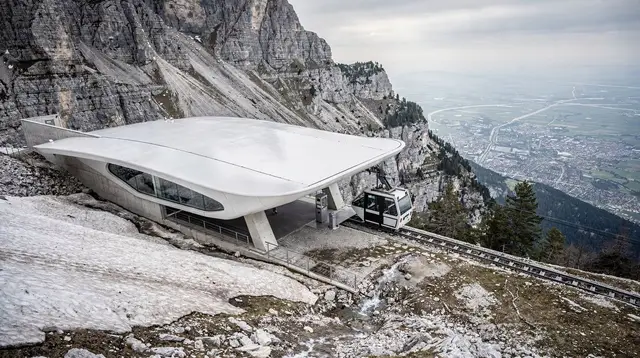
Innsbruck in Summer: Hiking, Via Ferrata and Adventure Season
When is the best time for hiking and outdoor sports around Innsbruck?
High-altitude trails around Innsbruck are usually reliably clear from late June or July, depending on the previous winter's snowfall, and stay open into September. Via ferrata, rafting, canyoning and paragliding all run through the same window, while the Nordkette's Seegrube can still hold snow patches in early summer even as the old town reaches 25 degrees.
Between June and September, Innsbruck stops being a ski town and becomes something closer to an outdoor sports hub with a historic old town attached. This is the season for hiking above the tree line, via ferrata routes with cable handrails bolted into the rock, whitewater rafting and canyoning in the valleys, and tandem paragliding off the Nordkette. It is also the season with the widest gap between what the weather is doing in the streets below the Golden Roof and what it is doing 1,300 metres higher up, and getting that gap wrong is the single most common way a summer trip here goes sideways.
What actually opens, and when
The honest starting point is that Innsbruck’s summer outdoor season does not begin on a fixed calendar date. High-altitude trails, especially anything above roughly 2,000 metres on the Nordkette or the Patscherkofel, are dictated by how much snow fell the previous winter and how quickly it clears in spring. In a light-snow year, routes from Hafelekar can be walkable by the second week of June. In a heavy-snow year, patches of old snow can linger into July on north-facing sections. The safe planning assumption is late June to early July for reliable high-trail access, with the window fully open by mid-July and staying good into September.
This is not a technicality. Every year, visitors arrive in the first days of June expecting the same open, snow-free Nordkette ridge they saw in a photo taken in August, and the lift attendants at Hungerburg spend a good part of early summer explaining why the upper trail is still closed or why crampons would be sensible on a shaded stretch. If your dates are fixed for early June, plan around valley and mid-altitude hikes rather than committing to a high alpine route, and treat any high-trail plan as conditional on a check closer to the date.
Lower and mid-altitude routes are far more forgiving. Valley walks along the Inn river, the wooded paths around Arzler Alm, and gorge walks such as the Ehnbach gorge near Zirl are typically accessible from May onward, well ahead of the high country.
Hiking: from an easy loop to a full mountain day
Innsbruck’s geography means a hiking trip can start directly from a tram stop. The Nordkette rises straight out of the city, reached in three connected cable car stages, and once at Seegrube or Hafelekar you are on genuine high alpine terrain with views back down over the rooftops of the old town. It is dramatic, but it is also steep, loose in places, and not the spot for a first-ever mountain walk without some experience or a guide.
an easy guided walk around the Nordkette is the more forgiving way to experience that terrain for a first visit, with a guide reading conditions and pacing the route rather than you working it out from a trail map at the top station.
South of the city, the Patscherkofel above Igls is the gentler of Innsbruck’s two house mountains — more forest, less exposure, and a better match for families or a first alpine outing. A guided sunrise hike up the Patscherkofel is a genuinely different experience from the same slope at midday: cool air, empty trails and the Inn valley filling with light below.
For a broad loop that takes in the city’s edges without committing to serious altitude, a guided Hausrunde walk around Innsbruck strings together several of the lower vantage points in a single half-day outing, which suits a first afternoon in town before deciding how much higher to go on subsequent days.
Families with younger children are usually better served by gorge and valley walks than by cable car hikes. The family hike through the Ehnbach gorge near Innsbruck follows a river gorge at the foot of the Martinswand rather than a mountain ridge, which means shade, flat sections and no altitude concerns, and it runs reliably all summer regardless of what the snowpack up on the Nordkette is doing that year.
Further afield, the Stubai valley and the Karwendel range both open into extensive networks of marked trails and staffed mountain huts through July and August, and a route such as hiking into the Ehrwald area’s alpine terrain can be built into a full day trip from the city. Anyone planning several consecutive hiking days is better off consulting a season guide to hiking conditions before locking in an itinerary, since huts and lifts each have their own opening dates that do not all line up.
| Area | Typical reliable window | Character |
|---|---|---|
| Nordkette / Hafelekar | Early-mid July to September | Steep, alpine, exposed, dramatic views |
| Patscherkofel | Late June to September | Gentler, more forested, family-friendly |
| Ehnbach gorge, valley walks | May to October | Low altitude, shaded, snow-independent |
| Stubai valley trail network | Late June to September | Extensive huts, glacier backdrop |
| Karwendel | Late June to September | Remote, longer approaches, fewer crowds |
Via ferrata: a step up in commitment
Via ferrata — protected climbing routes fitted with steel cables, rungs and ladders — sit between hiking and technical climbing, and the region around Innsbruck has routes across the full range of that spectrum. Easier routes are within reach of a fit hiker with no climbing background, given a harness, helmet and via ferrata lanyard set and some basic instruction; harder routes are genuinely exposed, physically demanding, and not the place to improvise.
A guide to via ferrata routes near Innsbruck is worth reading before choosing a route by difficulty rather than by scenery alone, and the Karwendel via ferrata routes in particular include some of the more serious options in the region.
a guided hiking tour into dramatic alpine terrain near Ehrwald is a good way to get a taste of exposed high-mountain walking with a guide managing the route-finding, before deciding whether to commit to a full via ferrata another day.
Like general hiking, via ferrata season depends on the snowpack: cable sections at higher elevations are only safe once the surrounding rock and approach paths are clear of snow and ice, which again usually means late June at the earliest.
Rafting and canyoning in the valleys
Whitewater sits lower down and is far less weather-dependent than the high trails, which makes it a reliable summer fallback whenever the mountains themselves are having an off day. The Imster Schlucht, one of the best-known whitewater stretches in the Alps, and the Ötztaler Ache both run organised rafting trips through summer, graded so that first-timers and experienced paddlers can each find a suitable stretch. Family-friendly, lower-grade sections exist too, which is why rafting works as a group activity in a way canyoning does not always manage.
Canyoning is the more physical of the two: descending a narrow gorge on foot, by abseil, slide and jump, wetsuit on, guide leading. The Auerklamm canyoning tour and the Alpenrosenklamm canyoning guide cover two of the signature routes in the Ötztal, and a broader introduction to canyoning for beginners is worth reading if you have never done it, since fitness and comfort with water and heights matter more here than in rafting.
Both activities run as guided half or full-day trips with all technical gear supplied, and both are almost entirely unaffected by whether the high alpine trails are clear yet, which makes them a solid plan B for the first half of June before the mountains fully open up.
| Activity | Physical demand | Weather/snow dependence | Good for first-timers |
|---|---|---|---|
| Rafting | Moderate | Low — runs from spring | Yes, on lower-grade sections |
| Canyoning | High | Low — runs from late spring | With a guide, yes |
| Via ferrata (easy routes) | Moderate to high | High — needs clear rock and approach | With a guide, yes |
| High-altitude hiking | Variable | High — needs cleared trails | Depends on route chosen |
Paragliding over the Inn valley
Tandem paragliding is one of the more memorable ways to see the relationship between the city and its mountains, launching from a site on the Nordkette above Innsbruck itself, or from sites further out in the Stubai valley and around Mayrhofen in the Zillertal.
Flights depend on wind and visibility rather than on trail conditions, so they run through the whole summer whenever the weather cooperates, with calmer air typically in the morning or early evening than in the heat of a summer afternoon. Operators postpone rather than fly in marginal conditions, so building a little flexibility into your schedule — an extra day, or a morning left open — improves the odds of the flight actually happening on your trip.
The temperature gap: why to pack a jacket on a hot day
This is the detail that catches visitors out more than any other in an otherwise straightforward summer itinerary. Innsbruck’s old town sits at about 574 metres, and a June or July afternoon there can comfortably reach 25 degrees, T-shirt weather among the arcades on Maria-Theresien-Straße. The Seegrube station on the Nordkette sits at roughly 1,905 metres, and it is entirely normal for that same afternoon to bring cloud, wind, a noticeably colder air mass, and — especially earlier in the season — leftover snow patches on shaded ground. A 15 to 20 degree swing between the valley floor and the mid-station is routine, not exceptional, and weather up there can also change faster than it does in town.
The practical takeaway is simple: if any part of your day involves riding a cable car up from the city, carry a warm layer and a light waterproof shell even if the forecast for Innsbruck itself looks perfect. This applies whether you are heading up for a serious hike, a shorter walk, or simply the view — the Alpenzoo, partway up the same slope at about 750 metres, sits in its own intermediate microclimate too.
Fitting summer activities into a trip
A useful way to think about a multi-day summer visit is to split it between a low-effort, weather-proof day and a high-effort, weather-dependent day, so a poor forecast on the mountain does not derail the whole trip. Rafting, canyoning, valley walks and museum visits in the old town can fill a day regardless of what the Nordkette is doing; hiking, via ferrata and paragliding are better scheduled with some flexibility, ideally checking conditions the evening before.
The things to do around hiking and mountains and via ferrata and climbing categories group activities by type if you want to compare several options at once, and the canyoning and gorges, whitewater rafting and paragliding categories work the same way for the water and air-based options.
For a trip built specifically around this season, an alpine hiking week itinerary lays out a full week that assumes the trails are open, with fallback suggestions worked in for the days they are not. It is worth reading alongside this page rather than instead of it, since the itinerary assumes the seasonal caveats covered here rather than repeating them.
What this page deliberately leaves out
This guide covers the non-snow outdoor season on purpose and does not get into skiing or snowboarding, which have their own dedicated season and their own set of pages once the Olympia SkiWorld lifts reopen in winter. If you are planning a winter trip instead, that is a different set of considerations — different lifts, different passes, different clothing — and belongs on a different page rather than folded into a summer guide.
Innsbruck summer season: frequently asked questions
When do the high mountain trails around Innsbruck actually open?
Most trails above roughly 2,000 metres, including routes from the Seegrube and Hafelekar, are usually clear from late June or July, but this depends entirely on how much snow fell the previous winter and how fast it melts. Some years the Nordkette is walkable in mid-June; other years patches linger into July. Checking current conditions before you plan a specific route matters more than trusting a calendar date.
Can it really be 25 degrees in the old town and snowing on the mountain the same day?
Yes, and it happens often enough in June that it should shape your packing list. The valley floor at about 574 metres and the Seegrube at roughly 1,905 metres can differ by 15 to 20 degrees, and a passing front can leave fresh snow up high while the city stays warm and dry. Carry a layer even on a hot day in town if you plan to ride a cable car up.
Do I need experience for via ferrata routes near Innsbruck?
There are routes for genuine beginners as well as serious multi-hour outings, and the difference matters — via ferrata grades run from easy scrambles with cable handrails to steep, exposed sections that call for a head for heights and some fitness. A guided introduction is the sensible way to try it for the first time, since it includes a harness, helmet and via ferrata set along with instruction.
Is rafting or canyoning better for a first-timer?
Rafting on the Inn or the Ötztaler Ache is the gentler introduction: you sit in a group boat, follow a guide’s calls, and the whitewater grade can be matched to your comfort level. Canyoning in gorges such as the Auerklamm or Alpenrosenklamm involves abseiling, jumping and sliding through the gorge itself, which is more physical and more committing. Both run as guided half-day trips with wetsuits and gear supplied.
What is the paragliding season like from Innsbruck?
Tandem paragliding runs through the summer whenever wind and visibility cooperate, with flights launching from the Nordkette above the city or from sites in the Stubai valley and around Mayrhofen. Morning and early evening tend to have calmer air than the middle of a hot afternoon, and flights are routinely postponed a day when conditions are not safe rather than flown regardless.
Which is the easier mountain for a first Innsbruck hike, Nordkette or Patscherkofel?
The Patscherkofel, south of the city above Igls, generally has gentler, more forested terrain and is the more forgiving choice for a first outing or a family with children. The Nordkette is steeper, more alpine and more exposed, with rewarding views but less margin for error on loose ground; it suits hikers who already have some mountain experience.
Do I need to book hiking, via ferrata, rafting, canyoning or paragliding trips in advance?
In July and August, popular guided rafting, canyoning and paragliding slots can sell out a few days ahead, especially on weekends, so booking earlier in the week is worth doing if your dates are fixed. Self-guided hiking needs no booking at all, only a check of the relevant cable car’s operating hours and the current trail status.
What should I pack for a summer hiking trip around Innsbruck?
Sturdy footwear with ankle support, a warm layer and a light waterproof shell even on a forecast-sunny day, sun protection for the strong high-altitude sun, and more water than you think you need. If you are heading above the tree line on the Nordkette or Patscherkofel, check the cable car’s last-descent time before you set out.
Seasonal experiences on GetYourGuide
Verified deep-linked GetYourGuide tours. Book through these links and we earn a small commission at no cost to you.
GetYourGuide does not provide a product photo for this activity — the image shows the meeting point, photographed by us.