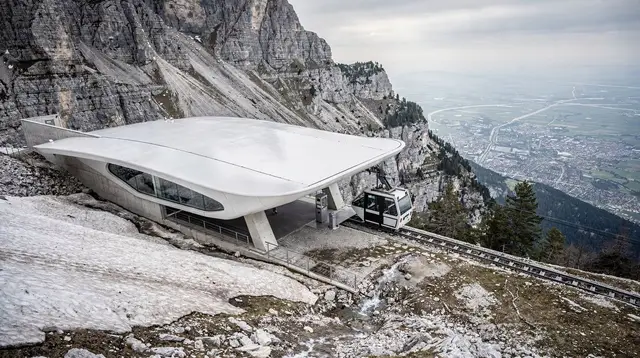
Via Ferrata Routes Near Innsbruck
Is there a via ferrata right in Innsbruck, on the Nordkette or the Patscherkofel?
Nothing confirmed sits inside the city or on those two mountains specifically — this guide does not have a verified route name, grade or elevation gain to give you for either. The nearest ranges known for via ferrata are the Karwendel and the Wilder Kaiser, both a short drive from Innsbruck, and the honest first step is a call to a local mountain guide office for the current list, since routes and ratings shift from year to year.
What’s Actually Confirmed, and What Isn’t
Innsbruck sells itself on how close its mountains sit to the old town — the Nordkette rises to 2,334 m at the Hafelekarspitze on one side of the valley, and the Patscherkofel climbs to 2,246 m on the other, both visible from almost any street in the centre. It’s a fair question, then, whether that same closeness applies to via ferrata (protected climbing routes with fixed cables, rungs and ladders) — whether you can step off a lift on the Nordkette or the Patscherkofel and clip onto a route without going anywhere near a valley an hour away.
This guide won’t pretend to answer that with a route name, a difficulty grade, or a stated elevation gain, because none of that is confirmed here. Via ferrata routes open, close, get re-graded and occasionally get dismantled from one season to the next, and giving you an invented name or a made-up “B/C” rating would be worse than useless — it would send you looking for something that may not exist, or send you up something with the wrong expectations about its exposure.
What this page can do is set the activity honestly against the terrain around Innsbruck that is actually documented, point you toward the ranges where via ferrata is established fact rather than guesswork, and tell you exactly who to ask for the list that’s current this month.
If you want the short version: check with a local mountain guide office before you plan a via ferrata day around a specific mountain near the city. That’s not a brush-off — it’s the honest answer, and it’s also how the routes themselves want to be approached, since conditions on fixed cable protection change with weather, rockfall and maintenance schedules in a way a guidebook or a website can’t track in real time.
The Two City Mountains, and Why This Guide Stops Short
The Nordkette is reached in three lift stages from the city centre — the Hungerburgbahn funicular up to Hungerburg, then the Seegrubenbahn to Seegrube, then the Hafelekarbahn to Hafelekar at around 2,256 m, with the summit of the Hafelekarspitze a short walk above that.
It’s well covered on this site for hiking, for the view back down over the rooftops of the old town, and for the Nordkette hiking trails that fan out from Hafelekar and Seegrube. What isn’t covered, because it isn’t verified, is a named via ferrata route on that terrain. The rock and terrain type up there could plausibly support one — but “plausibly could” is not the same as “does,” and this guide draws that line deliberately.
The Patscherkofel, the gentler mountain south of the city above Igls, is the same story. It’s a well-established hiking and cable-car destination — see the Patscherkofel hiking guide for what is confirmed there — but this guide has no checked via ferrata route to hand you for it either.
That’s a deliberately narrow line, and it’s worth being clear about why it matters. A page that invents a route name or a grade to sound complete would read fine right up until someone tried to act on it — showing up at a lift station looking for a route that turns out not to exist, or underestimating a route because a made-up grade sounded easy. The safer and more useful thing is to tell you plainly what’s confirmed and what isn’t, and to hand you the actual channel for finding out: a Innsbruck-based mountain guide office (Bergführerbüro), which keeps a season-by-season list of what’s open, what’s closed for maintenance, and what condition the cables and anchors are in.
Where Via Ferrata Is Actually Established in Tyrol
Two ranges within reach of Innsbruck are genuinely known for via ferrata, and each has its own guide on this site rather than a guess bundled into this one.
The Karwendel, the limestone range north of the Inn valley beyond Seefeld and Zirl, is one of the larger protected areas in the Austrian Alps and a recognised via ferrata destination — see the Karwendel via ferrata guide for what’s documented there.
The Wilder Kaiser, the limestone massif above the villages of Ellmau, Söll and Scheffau near Kitzbühel and St. Johann in Tirol, is a long-standing climbing and via ferrata area in its own right — see the Wilder Kaiser climbing guide.
Neither is a same-morning outing from a city-centre hotel the way the Nordkette lifts are, but both are within a manageable day’s drive or a guided transfer, and both are places where this site can point you to something real rather than something invented for the sake of an answer.
If You Want to Stay Close to the City
If the point of your trip is staying based in Innsbruck and doing day activities rather than relocating to a mountain village, there are two honest paths.
The first is a guided via ferrata outing booked through a local operator, which sidesteps the whole question of “which mountain, which route” — the guide picks a route appropriate to the group’s experience and the day’s conditions, supplies the gear, and handles the logistics of getting there and back from the city.
a guided via ferrata outing with a summit view, run from InnsbruckThe second is to treat the city mountains as what’s confirmed for them — hiking terrain and cable-car viewpoints, not (as far as this guide can verify) via ferrata terrain — and get your exposure and views that way instead.
an easier guided walk around the Nordkette, without needing via ferrata gearNeither substitutes for the other, but between them they cover both what’s actually documented about the mountains inside the city limits and what a guide can arrange further out.
Season: Don’t Plan This Around Winter, or Even Spring
Whichever range a via ferrata route turns out to be on, one fact is safe to state without a specific route in hand: high Alpine terrain around Innsbruck is not clear and safe for this kind of climbing year-round. The valley floor sits at roughly 574 m, but via ferrata terrain is typically well above that, on rock faces that hold snow and ice long after the city has turned green.
As a rough rule for the region, high trails and protected routes are usually not realistically climbable until late June or July, depending on how heavy the preceding winter was, and the window closes again by September or early October as snow returns to the higher elevations. See the season guide for hiking in Tyrol and Innsbruck in summer for the broader pattern — via ferrata sits inside that same window, if anything with less margin either side of it, since wet or icy cable and rungs are far more dangerous than a wet hiking trail.
Never book or plan a via ferrata day for April, May or early June expecting the routes to be clear. This is the single most common planning mistake for anyone arriving with a ski-season mindset and assuming the mountains “open” for summer activities the moment the snow starts melting in the valley.
| Period | What to expect on via ferrata terrain |
|---|---|
| December – March | Winter conditions; via ferrata routes are not in season |
| April – mid-June | Still-melting snow at altitude; do not plan around this window |
| Late June – September | The realistic season, confirm conditions before travel |
| October – November | Closing down; early snow can end the season abruptly |
Getting a Guide, and Why It’s the Right Default
For a first via ferrata outing, or any route on unfamiliar terrain, booking a certified mountain guide (Bergführer) is the standard and sensible approach, not an upsell. A guide supplies the harness, helmet and via ferrata set, matches the route to the group’s fitness and comfort with exposure, and — just as importantly — knows which routes are actually open and in good repair that week, since fixed cables and anchors need periodic maintenance and can be closed with little public notice.
a shorter guided route around Innsbruck for a first outing on exposed terrainIf you’d rather get your bearings in the city on foot before committing to a mountain day, a guided walk is a low-key way to talk to a local guide face to face and ask what’s realistic for your dates and experience.
a private guided walk through Innsbruck, a good first conversation with a local guideGear, in Brief
A via ferrata set is not optional equipment — it’s the whole point of the protection system. At minimum, plan on:
- A via ferrata lanyard with two carabiners and a built-in shock absorber (energy absorber), clipped to the fixed cable at all times except when moving a carabiner past an anchor point.
- A climbing harness, correctly fitted.
- A helmet — rockfall, not just a fall, is the main risk on many routes.
- Sturdy boots with ankle support and a stiff enough sole to stand on narrow rungs.
- Gloves are optional but common, since steel cable can be rough on bare hands over a long route.
None of this needs to be owned outright for a single outing. Guide offices and outdoor outfitters around Innsbruck rent the complete kit, and a guided trip typically includes it in the price.
What This Page Is Not Covering
This guide is specifically about via ferrata — protected climbing on fixed cable — and deliberately does not cover ordinary hiking on the Nordkette or the Patscherkofel, which is a different activity with its own guides: see Nordkette hiking trails and the Patscherkofel hiking guide. If you’re not sure which of the two you actually want, the practical difference is straightforward: hiking trails don’t need a harness or a via ferrata set, while via ferrata routes do, by definition, involve fixed cable protection over exposed terrain.
It’s also worth separating via ferrata from the via ferrata gear and safety basics guide on this site, which goes into more detail on technique and safety practice once you’ve chosen a route through a guide office, and from the broader climbing and via ferrata category, which rounds up everything this site has on the activity across Tyrol, including the confirmed routes in the Karwendel and Wilder Kaiser.
Planning the Rest of the Day
A via ferrata outing, especially a guided one with a transfer, tends to take up most of a day. If you’re building it into a longer stay, the things to do in Innsbruck hub and the alpine hiking week itinerary are useful starting points for what to pair it with — a quieter city-centre morning before or after, or a rest day built around Maria-Theresien-Straße and the old town rather than another mountain outing the next morning.
Getting to and from a trailhead outside the city, if your route ends up being in the Karwendel or the Wilder Kaiser rather than at the city mountains, is worth checking against the public transport guide for Innsbruck’s IVB and VVT network before assuming you’ll need a rental car.
If your dates fall outside the realistic via ferrata season, that’s not a wasted trip — it’s just a different kind of day. A guided city walk covers similar ground for orientation and local knowledge without depending on high-altitude conditions at all.
a short guided orientation walk through Innsbruck with a local, any seasonVia Ferrata Near Innsbruck: Frequently Asked Questions
Is there a via ferrata directly in the city of Innsbruck?
Not that this guide can confirm. Innsbruck’s city-limit mountains, the Nordkette and the Patscherkofel, are well documented for hiking and cable cars, but no specific via ferrata route on either one is verified here — check with a local guide office before assuming one exists at a given spot.
Can I do a via ferrata on the Nordkette?
Possibly, but this guide has no verified route name, grade or exposure rating for the Nordkette to pass on. Rather than guess, ask a Innsbruck-based mountain guide office directly, since they hold the current, checked list.
What about the Patscherkofel — is there one there?
Same answer as the Nordkette: nothing confirmed here. The Patscherkofel is well covered for hiking and its cable car, but a specific via ferrata claim on it isn’t something this guide can stand behind without a verified source.
Where are the nearest via ferrata routes that are actually documented?
The Karwendel range, north of Innsbruck, and the Wilder Kaiser, east near Kitzbühel and St. Johann in Tirol, are both established via ferrata areas in Tyrol and both a manageable drive from the city. See the dedicated guides for each range for what’s actually there.
When is via ferrata season around Innsbruck?
Roughly late June or July through September, weather and snow permitting. High Alpine terrain in Tyrol is usually still holding snow through May and into June, so this is not a year-round activity — always confirm current conditions before setting out.
Do I need a mountain guide, or can I go without one?
For a first via ferrata, or any route you haven’t done before, book a certified mountain guide. Local guide offices around Innsbruck run beginner-friendly outings with harnesses, helmets and via ferrata sets included, and they know which routes are actually open and in good condition that week.
What gear does via ferrata require?
At minimum a via ferrata set (lanyard with two carabiners and a shock absorber), a climbing harness, a helmet, and sturdy boots with good ankle support. Guide offices and outfitters rent the full kit, so you don’t need to own any of it for a single outing.
How do I find an up-to-date list of via ferrata routes near Innsbruck?
Contact a local mountain guide office (Bergführer) or an Innsbruck-based outdoor outfitter directly. Conditions, closures and new routes change from season to season, and they are the only reliably current source — a website or guidebook can be a year or more out of date.
Climbing and via ferrata on GetYourGuide
Verified deep-linked GetYourGuide tours. Book through these links and we earn a small commission at no cost to you.
GetYourGuide does not provide a product photo for this activity — the image shows the meeting point, photographed by us.