Public Transport in Innsbruck: IVB Buses vs the VVT Regional Network
What is the difference between IVB and VVT in Innsbruck?
IVB runs the city's buses, trams and the Hungerburg funicular within Innsbruck itself. VVT is the regional network covering the whole of Tyrol, including buses and trains out to Hall in Tirol, Wattens, the Stubai valley and Seefeld. Most VVT tickets also cover travel on IVB services inside the city.
Two networks, one ticket
Innsbruck runs on public transport more comfortably than most Alpine cities its size, largely because it operates two systems that hand off to each other cleanly. IVB (Innsbrucker Verkehrsbetriebe) is the city operator: buses, trams and the Hungerburg funicular cover almost every street in Innsbruck itself. VVT (Verkehrsverbund Tirol) is the regional network layered over the whole of Tyrol, running the buses and trains that leave the city for Hall in Tirol, Wattens, the Stubai valley and the Seefeld plateau.
The reassuring part is that visitors rarely need to think about which network they are on. Tyrol uses one integrated fare system, so a ticket bought for a regional VVT journey also covers the final leg on an IVB bus or tram inside the city, and vice versa. The practical distinction that matters is not the operator’s name on the ticket but the frequency and reach: IVB lines run every few minutes within the city, while VVT regional lines run on a timetable you should actually check, because gaps of thirty minutes to an hour are normal once you are out in a valley.
This guide keeps to the two networks themselves — how to ride them, what they cost, and which one gets you where. It does not cover the airport transfer, which is a short, separate hop on the F bus, and it does not cover the free ski shuttles bundled into the Olympia SkiWorld Innsbruck pass — those are a ski-season perk for pass holders, not part of the public network, and mixing the two up is the single most common planning mistake visitors make here.
IVB: the city network
IVB operates Innsbruck’s buses, trams and the funicular up to Hungerburg. Coverage inside the city is dense enough that most visitors staying in the old town or along Maria-Theresien-Straße can reach almost every sight on foot anyway, but IVB earns its keep on the slightly longer hops: out to Igls and the base of the Patscherkofel cable car, up to the Alpenzoo, across to Ambras Castle, or down to the Bergisel ski jump.
The tram network is small but useful: it links the main station area with the old town and runs out toward Igls on a scenic route that is a mild attraction in its own right, climbing gently out of the valley floor with views back over the city. Buses fill in everywhere else, including the routes up into the hillside suburbs of Mutters and Natters above the Wipptal.
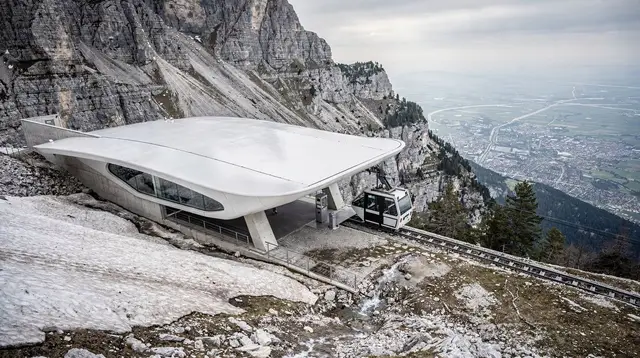
Funicular note. The Hungerburgbahn — the striking Zaha Hadid-designed funicular that carries the first stage up toward the Nordkette — is operated as part of the Nordkette cable car chain, not as a flat-fare IVB line, and a standard city ticket does not cover it. It has its own fare, bundled with the cable cars above it or included in the Innsbruck Card. Details on riding it are in the Nordkette cable car guide.
IVB tickets, in practice
| Ticket type | Typical use | Roughly covers |
|---|---|---|
| Single ride | One bus or tram trip | 60 minutes, one direction, transfers included |
| 24-hour ticket | A day of sightseeing by bus and tram | Unlimited IVB rides for 24 hours |
| Weekly ticket | A stay of five days or more | Unlimited IVB rides for 7 days |
| Innsbruck Card | Sightseeing plus transport | IVB transport for the card’s validity, plus cable car rides and museums |
Tickets are sold from machines at major stops, from the driver on boarding (cash or card, at a small surcharge on some lines), and through the IVB mobile app, which is usually the easiest option for a short stay. Whether the Innsbruck Card is worth buying depends almost entirely on how many cable cars you plan to ride during its validity — for transport alone, a 24-hour or weekly ticket is cheaper.
VVT: the regional network
VVT is where things open up. It is the transport association for the whole of Tyrol, running regional buses and the local train lines (S-Bahn) that connect Innsbruck to the surrounding valleys. For a visitor based in the city, VVT is what makes day trips without a rental car realistic.
East along the Inn valley. Regional buses and trains reach Hall in Tirol in well under twenty minutes — frequent enough that Hall functions almost like an extension of Innsbruck’s own transit map. Wattens, home to Swarovski Crystal Worlds, is a short train or bus ride further, and the attraction runs its own connecting shuttle from Wattens station, a detail covered in the tickets and transfer guide.
Continuing east, VVT and rail services also reach Schwaz, Jenbach and on toward the Zillertal, though side valleys like Zillertal itself are usually finished off by a connecting regional bus rather than the main train line.
South-west to the Stubai valley. VVT buses run directly from Innsbruck to Neustift and Fulpmes in the Stubai valley, a journey of roughly 45 minutes. This is an ordinary scheduled bus, useful for hiking and villages, and it is worth being precise about what it does not do: it stops in the valley towns, not at the Stubai Glacier lift base itself, which usually needs a further short connecting bus or, on ski days, is covered separately by the Olympia SkiWorld shuttle system described in the skiing guide, not by this regional fare.
North-west to Seefeld. The train line from Innsbruck Hauptbahnhof to Seefeld is one of the more scenic short rides in the region, climbing out of the Inn valley to the plateau at around 1,180 m in about 45 minutes, with connections on toward Zirl and the Außerfern beyond.
West along the Inn. VVT services also run out toward Imst and into the Ötztal, though the Ötztal’s own villages — Sölden included — are far enough up a side valley that the regional bus schedule thins noticeably; this is one of the corridors where a rental car starts to make more sense for a multi-stop day, a question addressed directly in getting to Stubai, Ötztal and Seefeld by public transport.
VVT tickets, in practice
VVT uses a zone-based fare, so the price of a ticket depends on how many zones a journey crosses rather than a flat regional rate. In practice this means:
| Destination from Innsbruck | Approx. journey time | Fare logic |
|---|---|---|
| Hall in Tirol | 15-20 minutes | Adjacent zone, low fare |
| Wattens | 20-25 minutes | Two zones out |
| Seefeld | About 45 minutes | Several zones, higher fare |
| Neustift, Stubai valley | About 45 minutes | Several zones, higher fare |
| Imst | About 45 minutes | Several zones, higher fare |
Tickets can be bought at station machines, on board some regional buses, and through the VVT “Smart Ride” app, which calculates the correct zone fare automatically and is the least error-prone option for visitors unfamiliar with the zone map. As with IVB, a VVT ticket that covers a journey into the city also covers the connecting IVB bus or tram at the Innsbruck end — there is no need to buy a second ticket to finish the trip.
The mistake to avoid: VVT is not the ski shuttle
It is worth stating plainly, because the confusion is common and the two systems look similar from a distance. The free ski buses that come with the Olympia SkiWorld Innsbruck pass are a ski-season-only service, run specifically to move pass holders between the city and the participating ski areas — Nordkette, Patscherkofel, Axamer Lizum, Muttereralm, Kühtai, Schlick 2000, Rangger Köpfl, Glungezer and the Stubai Glacier. They are free to ride, but only with a valid ski pass, and they exist to solve a skiing-specific problem: reaching a different mountain from the city centre each day.
VVT is a completely different thing: a year-round public network, open to anyone with an ordinary ticket, whose job is general-purpose transport to towns and villages — not lift bases. A VVT bus to Neustift will drop a hiker in the middle of the Stubai valley in July with no connection to skiing at all. Planning a ski week around VVT timetables, or expecting a regional VVT ticket to get onto a ski shuttle, both lead to the same avoidable confusion. If skiing is the goal, the ski pass guide is the one to read; if the goal is reaching a valley or town on an ordinary day, this page and VVT are the right tool.
Putting a day together
A day trip east is the easiest to build without a car: a VVT bus or train to Hall in Tirol for the old town and mint, continuing to Wattens for Swarovski Crystal Worlds, then back to Innsbruck by the same line — all on one zone-based ticket without needing to plan around a single tour departure time. A day toward Seefeld works the same way by train, and the Stubai valley by regional bus, provided the timetable back down is checked before setting off, since evening frequency on these routes drops off faster than on the city’s own IVB lines.
For visitors who prefer a fixed structure rather than assembling connections themselves, a half-day city walk removes the transit planning from the old town portion of a trip: a short guided walk through the old town with a local host covers the historic centre on foot in under two hours, leaving the rest of the day free for a VVT trip out to the valleys.
Visitors weighing sightseeing against transport costs for a single day in the city can also compare against the Innsbruck city card that bundles public transport with museum and cable car access, though as noted above it only ever covers the IVB city network, never VVT trips beyond the city line.
For an active day up the Nordkette that starts inside the city network, a guided easy hike around the Nordkette ridge begins from the top lift station reached via the Hungerburgbahn, and pairs naturally with an IVB ticket for the flat part of the journey through the city. And for a slower look at the old town itself before heading out on transit, a ticket up the City Tower for a rooftop view over the rooftops and mountains is a five-minute stop that needs no transport planning at all.
Getting around Innsbruck and its valleys, at a glance
- IVB covers Innsbruck itself: buses, trams and the Hungerburg funicular’s onward cable cars.
- VVT covers the whole of Tyrol: regional buses and trains to Hall, Wattens, the Stubai valley, Seefeld and beyond.
- One integrated fare system links them — a VVT ticket into the city also works on IVB.
- The Innsbruck Card covers IVB transport plus cable cars and museums, but never VVT trips outside the city.
- The free Olympia SkiWorld ski shuttles are a separate, season-only, pass-holder-only system — not VVT, and not usable with an ordinary transport ticket.
- Regional VVT frequency drops off noticeably outside the city and in the evening, so checking the timetable back is worth the two minutes it takes.
Frequently asked questions about IVB and VVT in Innsbruck
Do I need separate tickets for IVB and VVT?
No. Tyrol uses a single integrated fare system, so a VVT ticket bought for a regional trip also works on IVB buses and trams inside Innsbruck. You do not need to buy a second ticket to finish a journey in the city centre.
Can I reach the Stubai valley and Seefeld by public transport?
Yes. VVT regional buses run from Innsbruck to Neustift and Fulpmes in the Stubai valley, and VVT trains run from Innsbruck Hauptbahnhof to Seefeld in around 45 minutes. Both are ordinary scheduled services, not tour buses.
Is the VVT network the same as the free ski bus system?
No, and this is the most common mix-up. The free ski shuttles that come with the Olympia SkiWorld Innsbruck pass are a separate, ski-season-only system run for pass holders. VVT is the year-round public network anyone can ride with an ordinary ticket, whether or not they are skiing.
How do I get from Innsbruck to Hall in Tirol or Wattens without a car?
Regional VVT buses and trains connect Innsbruck to both towns in well under half an hour. Hall’s old town is served by frequent buses from the city centre, and Wattens, for Swarovski Crystal Worlds, is reached by train or bus plus the short shuttle that runs from Wattens station.
Does the Innsbruck Card include public transport?
The Innsbruck Card includes IVB public transport within the city for its full validity period, plus one return ride on several cable cars and free museum entry. It does not extend to the regional VVT network beyond the city boundary.
Do buses and trams run late at night in Innsbruck?
Daytime frequency is high on the main IVB lines, but service thins out in the evening and stops around midnight on most routes, with a small number of night lines on weekends. Check the return time before heading up to Hungerburg or out to the suburbs late in the day.
Is it worth renting a car instead of using public transport?
For Innsbruck itself, Hall, Wattens, Seefeld and the Stubai valley, no — public transport covers all of them directly and parking in the old town is restricted and expensive. A car becomes more useful only for reaching smaller villages in the Ötztal, Zillertal or Kitzbühel Alps off the main VVT corridors.
Recommended tours on GetYourGuide
Verified deep-linked GetYourGuide tours. Book through these links and we earn a small commission at no cost to you.
GetYourGuide does not provide a product photo for this activity — the image shows the meeting point, photographed by us.