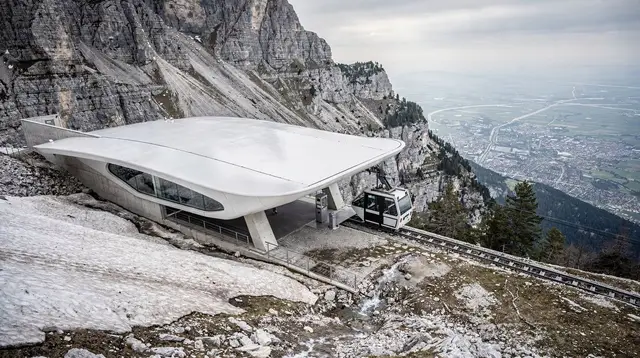
Can You Ski a Different Mountain Every Day from Innsbruck?
Can you stay in Innsbruck and ski a different mountain every day without a car?
Yes. The Olympia SkiWorld Innsbruck pass covers nine ski areas around the city — including Nordkette, Patscherkofel, Axamer Lizum, Muttereralm, Kühtai, Schlick 2000, Rangger Köpfl, Glungezer and the Stubai Glacier — and free ski buses run from the city centre to each one. Staying in town and picking a different mountain each morning is the pattern most locals actually use.
The city-base ski pattern, and why it works here
Most ski trips start with a resort village and end with whichever single mountain sits above it. Innsbruck flips that. The city itself is the base — hotels, restaurants, a train station and an airport all in one place — and the skiing happens on nine separate mountains scattered around it, each one a short bus ride away. The question visitors keep asking is whether this is a genuine, practical way to spend a week, or a marketing simplification. It is genuine, and it is the pattern that locals themselves use: check the forecast each evening, pick whichever of the nine areas has the best snow or the clearest sky, and take the free bus there in the morning.
This is not a workaround invented for tourists. Innsbruck residents who ski regularly rarely commit to a single home mountain the way a resort-village skier does, because doing so would mean ignoring eight other options within a thirty-to-forty-five-minute bus ride. The Olympia SkiWorld Innsbruck ski pass is what ties the nine areas together into one product, and the free ski bus network is what makes moving between them practical without a car.
This page is about the shape of that pattern — which mountains are on it, how the free buses fit together, and the one mix-up that trips visitors up. Pass prices and purchase details live on the dedicated pass guide linked above; this page assumes you already know the pass exists and want to know how a week built around it actually runs.
The nine areas, at a glance
The Olympia SkiWorld Innsbruck pass covers nine ski areas in a ring around the city. They are not interchangeable — some are small local hills, one is a full glacier, and one is unusually steep and freeride-oriented for a city mountain — so the point of the rotation is variety, not repetition.
| Area | Character | Typical day |
|---|---|---|
| Nordkette | Steep, freeride-oriented, reached straight from the city centre | Advanced skiers, dramatic city views |
| Patscherkofel | Sunny, mixed terrain south of the city | All-round day, good visibility |
| Axamer Lizum | Former 1964 and 1976 Olympic slalom venue, family-friendly | Beginners and families |
| Muttereralm | Compact, gentle, close to Mutters | Easy day, short transfers |
| Kühtai | High-altitude, snow-reliable | Later-season reliability |
| Schlick 2000 | Above Fulpmes in the Stubai valley | Mixed terrain, valley views |
| Rangger Köpfl | Small, uncrowded local hill | Quiet, relaxed day |
| Glungezer | Panoramic, less commercialised | Views, fewer crowds |
| Stubai Glacier | Full glacier ski area, long season | Highest, most reliable snow |
Each of these has its own character, its own gradient, and its own reasons to visit — that level of detail belongs on each area’s own page, and on the Nordkette freeride guide and Stubai Glacier skiing guide for the two most-asked-about areas. What matters here is simply that all nine sit on the same pass and the same free bus network, which is the part that makes the rotation possible in the first place.
How the free ski buses actually work
The free ski bus network is the mechanism that turns nine separate mountains into one week’s itinerary without a rental car. Buses run from pickup points in and around Innsbruck out to each of the nine Olympia SkiWorld areas during the ski season, and they are included for anyone holding a valid pass for that day — no separate ticket, no extra cost.
The practical details that matter for planning a rotation:
- Routes differ by area. The bus that reaches Axamer Lizum is not the same bus that reaches Kühtai or the Stubai Glacier. Each area has its own route and its own pickup points, and not every city-centre stop serves every mountain.
- Journey times vary. A mountain like Patscherkofel, close to the city, is a short hop. Kühtai and the Stubai Glacier sit further out and take longer — worth knowing before committing to a first lift time.
- Timetables can shift between seasons. Because this is a seasonal transport service layered onto public infrastructure, confirm the current route and departure times for the specific mountain you plan to ski the night before, rather than assuming last year’s schedule still applies.
- They only run in ski season. Outside the winter months these are not operating buses at all — this only applies to the roughly December-to-April window when the passes and lifts are active.
For a week built around several of the nine areas, the practical routine most visitors settle into is: check tomorrow’s snow and weather report each evening, decide which mountain suits it best, then confirm that area’s specific bus stop and departure time before heading out. It sounds like more planning than picking one resort and staying put, but in practice it takes a few minutes and becomes routine after the first day or two.
The mistake to avoid: ski buses are not VVT buses
This is the one point worth being precise about, because getting it wrong leaves a visitor stranded at the wrong bus stop with skis on their shoulder.
The free ski buses exist for one purpose: connecting the city to the nine areas on the Olympia SkiWorld Innsbruck pass. They are part of the ski pass system, they run only in season, and they go nowhere else.
VVT is Tyrol’s regional public transport network — the buses and trains that cover the wider region, including valleys that are not part of the Olympia SkiWorld system at all. The Ötztal and the Seefeld plateau, both popular ski destinations in their own right, sit outside the nine-area system and are reached on regional VVT services with their own separate tickets, not on the free ski buses.
A guest who wants to add Sölden or Seefeld to a ski week needs a different transport plan and a different pass altogether — covered on the guide to reaching ski resorts outside the SkiWorld pass and the wider public transport guide to IVB and VVT.
The confusion is understandable — both are buses, both are connected to skiing, and both start from stops in or near Innsbruck. But treating them as one system is the single most common planning error in a city-base ski week, and it is worth fixing before the trip rather than at a cold bus stop at 8 a.m.
Building a week around the rotation
A realistic multi-day version of this pattern looks less like a rigid schedule and more like a short list of candidates, matched to conditions each evening. A few patterns that work well in practice:
Two to three days. Pick two contrasting areas rather than racing through four. A common pairing is one easier, closer mountain — Muttereralm, Axamer Lizum or Rangger Köpfl — with one bigger day, such as Nordkette for advanced skiers or the Stubai Glacier for reliable high-altitude snow.
Four to six days. This is where the rotation earns its reputation. A week might run: Patscherkofel on a clear first day for the views, Nordkette when conditions favour steeper terrain, an easier day at Axamer Lizum or Muttereralm, Kühtai or the Stubai Glacier for altitude insurance later in the trip, and one of the quieter areas — Rangger Köpfl, Glungezer or Schlick 2000 — for a lower-key finish.
A week or more. At this length it becomes realistic to cover most or all nine areas at least briefly, using weather and snow reports to decide the order rather than fixing it in advance. This is closer to how long-term Innsbruck residents actually use the pass than any single suggested itinerary can be — the itinerary for an Olympia SkiWorld ski week sketches one version of this longer rotation day by day.
Whichever length of stay, the constant is the same: decide the night before, based on where the snow and weather are best that day, rather than locking in a fixed order weeks in advance. That flexibility is the actual advantage of skiing from a city rather than from inside a resort.
Who this pattern suits, and who it does not
Basing a ski trip in Innsbruck and rotating mountains suits skiers who want variety, who are travelling without a car, or who are combining skiing with city time — museums, the Christmas markets in December, or simply a hotel with restaurants within walking distance rather than a resort-village supermarket. It also suits mixed-ability groups: a family with a mix of beginners and confident skiers can send the beginners to Axamer Lizum or Muttereralm on a day when the more advanced skiers head for Nordkette, then reunite in the city that evening. The guide to family and beginner skiing around Innsbruck covers this split in more detail.
It suits less well a skier whose main goal is maximum vertical and lift-served terrain on a single big mountain with minimal transfer time — a dedicated resort base will usually win on sheer lift access for that specific goal. It is also not the right frame for anyone planning to ski the Ötztal or Seefeld as their main destination, since those sit outside the nine-area system entirely, as covered above.
For everyone in between — which is most visitors — the honest answer to “can I stay in Innsbruck and ski somewhere different every day without a car” is yes, and it is not an improvised workaround. It is the pattern the pass and the free bus network were built for, and the one Innsbruck itself uses. Season dates and reliable snow windows for the different areas are covered on the guide to when to ski Innsbruck, and city-based logistics such as the Innsbruck Card are worth checking separately, since the ski pass and the sightseeing card are two different products that solve two different problems.
Between ski days, the Nordkette cable car and Patscherkofel cable car both run for non-skiers too, so a rest day up either mountain — a sunrise outing on the Patscherkofel is one way to see it without skis — still counts as a mountain day even without boots on.
A visit to the Bergisel Olympic ski jump arena ties the modern ski week back to the city’s 1964 and 1976 Winter Olympics history, and for something further afield, a snowshoe outing on the Zugspitze or, for the more adventurous, a cold-water dip in a mountain lake both make a memorable non-ski day within the same trip.
Frequently asked questions about skiing a different mountain from Innsbruck
Do I need a car to ski from Innsbruck?
No. The nine areas on the Olympia SkiWorld Innsbruck pass are connected to the city by free ski buses, and Nordkette and Patscherkofel are reachable by cable car straight from the city itself. A car adds nothing for these mountains and mostly adds parking hassle.
How many ski areas does the Olympia SkiWorld pass actually cover?
Nine: Nordkette, Patscherkofel, Axamer Lizum, Muttereralm, Kühtai, Schlick 2000, Rangger Köpfl, Glungezer and the Stubai Glacier. They differ in size and character, from a small local hill to a full glacier ski area, so treat them as nine different days out rather than nine versions of the same slope.
Are the ski buses the same as the regional VVT buses?
No, and this is the mistake to avoid. The free ski buses only serve the nine Olympia SkiWorld areas. The Ötztal and Seefeld are skied on separate lift systems and are reached by the regional VVT public transport network, which is a different service with its own tickets.
Can I ski the Stubai Glacier on the same pass as Nordkette?
Yes, the Stubai Glacier is one of the nine areas included on the Olympia SkiWorld Innsbruck pass, alongside the eight lower mountains around the city. It is usually the day people set aside for the highest and most reliable snow.
Is it worth picking a different mountain each day, or better to return to one?
For a stay of three days or more, rotating mountains is the more efficient use of a multi-day pass and shows the honest range of terrain around Innsbruck. For a two-day trip, most visitors are happier picking two contrasting areas — one close and easy, one bigger — rather than rushing between four.
Which mountains are best for beginners and families in this rotation?
Axamer Lizum, Muttereralm and Rangger Köpfl are generally the gentler, more family-oriented areas in the nine. Nordkette is the outlier — it is known for steep freeride terrain above Seegrube rather than easy cruising.
How do I know which bus goes to which mountain?
The free ski bus network has separate routes and separate pickup points for different areas, and not every stop serves every mountain. Confirm the current route and timetable for the specific area you plan to ski before setting out, since routes can be adjusted between seasons.
Does staying in Innsbruck cost more than staying at a single ski resort?
It depends on the resort compared, but a city base usually keeps accommodation and food costs closer to city-market rates than to peak-season resort-village prices, while the free ski buses remove the cost of a hire car or a resort shuttle.
Skiing and snowboarding on GetYourGuide
Verified deep-linked GetYourGuide tours. Book through these links and we earn a small commission at no cost to you.
GetYourGuide does not provide a product photo for this activity — the image shows the meeting point, photographed by us.