Skiing the Nordkette: Freeride Above Innsbruck
Can you actually ski on the Nordkette above Innsbruck?
Yes, but it suits advanced and expert skiers only. Three linked lifts — the Hungerburgbahn funicular, the Seegrubenbahn and the Hafelekarbahn — carry you from the city centre to 2,256 m in about 20-25 minutes, opening onto steep, largely off-piste freeride terrain with almost no easy runs.
Ask a first-time visitor whether they can ski above Innsbruck’s rooftops and the honest answer is yes — but not the way most people picture it. There is no single cable car swinging up to a ski station. Getting onto snow on the Nordkette means riding three separate lifts, one after another, and once you are up there, the terrain is not the kind that forgives a shaky snowplough turn. This guide is about that specific question: what Nordkette skiing actually involves, who it suits, and how to get onto it without wasting a lift ticket on ground you are not ready for.
Three Lifts, Not One Cable Car
The mistake almost every guidebook photo encourages is thinking of the Nordkette as a single ride. It is not. Reaching skiable snow from the middle of Innsbruck means changing lifts twice, at two different mountain stations, with three distinct machines doing the work:
| Stage | Lift | From | To | Approx. altitude gain |
|---|---|---|---|---|
| 1 | Hungerburgbahn funicular | City (Congress) | Hungerburg | ~574 m → ~860 m |
| 2 | Seegrubenbahn cable car | Hungerburg | Seegrube | ~860 m → ~1,905 m |
| 3 | Hafelekarbahn cable car | Seegrube | Hafelekar | ~1,905 m → ~2,256 m |
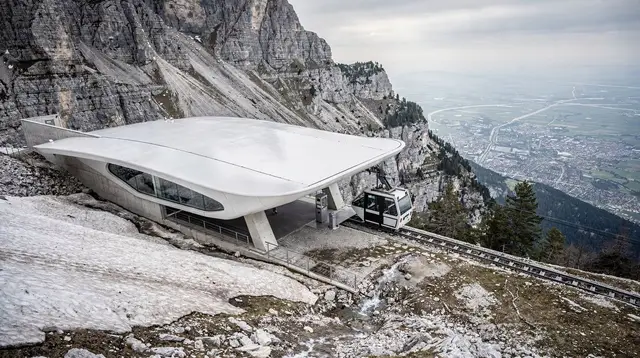
Ridden back to back with minimal waiting, the whole ascent takes roughly 20 to 25 minutes — a genuinely remarkable number for a lift system that starts inside a European city centre. The Hungerburgbahn’s stations, along with the tower at Bergisel, were designed by Zaha Hadid; the Seegrubenbahn and Hafelekarbahn are more workmanlike cable cars built for the job of hauling skiers and their equipment. None of this is walkable in a normal day trip, and none of it is one ticket for one gondola: budget time for two changeovers, and expect queues at Hungerburg on a powder morning as skiers wait for a Seegrubenbahn car with room for skis.
Skis and boards travel with you in the cabins rather than on an external rack, which is normal for this kind of urban-adjacent lift but still worth knowing before your first ride — get your gear organised at the base station rather than fumbling with poles in a crowded cabin.
What the Terrain Is Actually Like
This is the part that separates the Nordkette from almost every other lift-served mountain around Innsbruck: once you step off the Hafelekarbahn, there is very little easy skiing. The pitch from Seegrube down is steep by any resort’s standard, the marked piste is short, and most of what draws skiers up here is genuinely off-piste — couloirs, north-facing bowls, and lines that hold good snow because the Nordkette’s north wall barely sees the sun in midwinter. It has a reputation among Austrian freeriders roughly the way a handful of famously steep resort walls have elsewhere: a place locals ride hard and casual holidaymakers are told, kindly, to admire from the viewing platform instead.
There is one groomed run back to Hungerburg, and it gets skied by a wide range of ability levels because it is the only way down that stays on-piste. But the terrain most people ride the Hafelekarbahn for — the open faces below Hafelekar, the lines dropping toward Seegrube — is unpatrolled, unmarked and exposed to avalanche risk that varies by the day, the wind, and the last snowfall. This is not resort skiing with a safety net. Ski patrol does not groom or bomb these slopes the way a conventional resort would, and rescue, if it is needed, takes longer here than it would on a marked run inside a managed ski area.
None of that is a reason to avoid it if you are the right skier for it. It is a reason to be honest about who that skier is.
Who Should Actually Ski the Nordkette
Advanced and expert skiers and riders, ideally with a guide. If you are comfortable on steep, ungroomed terrain, can assess and avoid obvious avalanche danger, and are carrying the right equipment, the Nordkette delivers something few cities in the world can offer: proper freeride terrain reachable by public transport in under half an hour. Hiring a local mountain guide for a day is the standard, sensible move here — not a tourist upsell. Guides know which aspect held snow after the last Föhn wind, which slopes are tracked out, and which are quietly dangerous that morning regardless of how good they look from the lift.
Intermediates who want a scenic warm-up run. The single groomed piste from Seegrube to Hungerburg is skiable by a confident intermediate, and riding all three lifts just for that run, with the views over the Inn valley on the way down, is a legitimate half-day out. Just don’t expect a network of blue and red runs waiting at the top — there isn’t one.
Beginners: not here. This is the plainest advice this guide can give. If you are still working on parallel turns, the Nordkette is the wrong classroom. The Olympia SkiWorld Innsbruck pass that covers the Nordkette also covers gentler ground at Patscherkofel, Axamer Lizum, Muttereralm and Kühtai, all reachable by the same free ski buses from the city, and all far better suited to learning. Save the Nordkette for a return trip once your skiing has caught up with the terrain.
How the Nordkette Fits the Wider Ski Area
The Nordkette is one area within the Olympia SkiWorld Innsbruck pass, not a standalone resort, and it is worth understanding where it sits in that bigger picture before buying a lift ticket. The pass bundles the Nordkette together with Patscherkofel, Axamer Lizum, Muttereralm, Kühtai, Schlick 2000, Rangger Köpfl, Glungezer and the Stubai Glacier, and free ski buses connect them all from the city centre — the local pattern of basing yourself in Innsbruck and skiing a different mountain each day depends on that network.
For a full comparison of what the pass covers and whether it makes sense for your trip, the dedicated Olympia SkiWorld guide goes into pricing and area-by-area detail that this page does not duplicate. If your priority is gentler groomed skiing rather than freeride, the Patscherkofel cable car guide and the dedicated family and beginner skiing guide are the more useful starting points.
Season, Snow and Timing
Ski season on the Nordkette runs roughly from December into April in an average year, but this is exposed, largely sun-facing high alpine terrain above a relatively low base station, and snow cover swings more from year to year than it does on a glacier. A late December with a thin base is not unusual, and neither is a surprisingly good April if the winter delivered late snow. Check the lift operator’s live snow report before committing a day to it rather than assuming the season dates guarantee conditions — the general shape of the Tyrolean ski calendar, including how the shoulder months behave, is covered in the ski season dates guide.
The Föhn, the warm dry wind that periodically sweeps down from the south, is worth watching specifically here: it can strip snow from exposed faces surprisingly fast and change avalanche conditions within a single day. Locals treat a Föhn forecast as a reason to double-check plans, not just a headache-inducing curiosity.
Mornings after a fresh snowfall bring queues at the Hungerburgbahn base station as freeriders line up for first tracks — arriving early is a real strategy here, not just travel-guide advice.
Getting There and Getting Organised
Because the base of the whole system sits inside the city, there is no need for a car or a resort transfer. From the old town, the Hungerburgbahn’s Congress station is a short walk or a quick tram ride away, which is precisely what makes the Nordkette unusual: you can have breakfast in a café on Maria-Theresien-Straße and be clicking into skis on a 2,000-metre mountain less than half an hour later. Ski and boot rental is available in the city and at Hungerburg if you are travelling without your own gear, and it is worth sorting rental before you start queuing for lifts rather than after.
For visitors who want the views and the lift ride without the ski gear — genuinely the majority of people who ride these three lifts on any given day — that side of the Nordkette experience, including hiking routes from Seegrube and Hafelekar in the snow-free months, is covered in the Nordkette cable car guide, the Hungerburgbahn and its Zaha Hadid stations, and the Hafelekar and Seegrube hiking guide. This page stays focused on the ski terrain rather than repeating that sightseeing content.
If you want to build a full winter view of the city into your trip, the Bergisel Olympia ski jump makes a natural pairing on a rest day from skiing — walking the same tower where a Four Hills Tournament round is jumped every January.
book a ticket to the Bergisel Olympia ski jump arena for a rest-day look at Innsbruck’s other Olympic landmark, including the tower views over the valley you were skiing that morning.
Alternatives If the Nordkette Isn’t for You Yet
Not every visitor to Innsbruck in winter is chasing steep freeride lines, and the city does not expect them to. If the terrain described above sounds like more mountain than you want this trip, three honest alternatives are worth knowing:
- Ride the lifts without skiing. The same Hungerburgbahn, Seegrubenbahn and Hafelekarbahn combination is a spectacular outing on its own, snow season or not, and it is treated as a separate destination experience in the Nordkette cable car guide.
- Ski somewhere gentler on the same pass. Patscherkofel, just across the valley, has a far friendlier mix of runs and is detailed in the Patscherkofel cable car guide.
- Trade skis for another way onto the mountain. In the shoulder months and summer, the same slopes host hikers and mountain bikers rather than skiers — the Nordkette hiking trails guide covers that side of the mountain, and a guided outing lower down the valley is another way to see Alpine terrain without committing to expert-level skiing.
a guided e-bike tour along the base of the Nordkette is a good option on a non-ski day, or for anyone travelling with a group that doesn’t all ski.
If you’d rather stay in the city and take in views of the range you’d otherwise be skiing, a guided panoramic hike across the Telfer Wiesen gives non-skiers a look at the Nordkette’s lower slopes without the lift queues or the steep terrain.
Planning Around a Ski Day
Because the Nordkette is city-adjacent rather than resort-based, it slots easily into a trip that mixes skiing with sightseeing in a way a standalone resort stay doesn’t. A realistic day looks like: breakfast in the old town, three lifts up, a morning of skiing or a guided freeride session, lunch at Seegrube, and an afternoon back in the city for the Golden Roof or a wander through Innsbruck’s old town — all without touching a car.
If skiing is only one part of a longer Tyrol itinerary, it’s worth pairing the Nordkette with a broader look at the things to do around skiing and snowboarding in the region, or checking the seasonal honesty of a shoulder-season visit in the season dates guide before you lock in dates.
For visitors curious about the group tour side of things once the boots come off, a guided welcome tour of Innsbruck’s old town is a low-effort way to fill an afternoon after a demanding morning on the mountain.
Nordkette Skiing at a Glance
| Question | Short answer |
|---|---|
| Beginner-friendly? | No — steep, mostly off-piste terrain |
| Number of lifts to the snow | Three: Hungerburgbahn, Seegrubenbahn, Hafelekarbahn |
| Time from city centre | About 20-25 minutes |
| Top skiable lift station | Hafelekar, about 2,256 m |
| Guide recommended? | Yes, for anything beyond the one groomed run |
| Part of a multi-mountain pass? | Yes, Olympia SkiWorld Innsbruck |
| Typical season | Roughly December to April, snow-dependent |
Frequently Asked Questions About Skiing the Nordkette
Is the Nordkette one cable car or several?
Three separate lifts, ridden one after another: the Hungerburgbahn funicular from the city to Hungerburg at about 860 m, the Seegrubenbahn on to Seegrube at about 1,905 m, and the Hafelekarbahn up to Hafelekar at about 2,256 m. There is no single gondola that does the whole climb.
Can beginners ski the Nordkette?
Not really. The terrain served by the Seegrubenbahn and Hafelekarbahn is steep and mostly off-piste, with only a short groomed run back down to Hungerburg. Beginners and most intermediates are better off at Patscherkofel or one of the gentler areas on the Olympia SkiWorld pass.
How long does it take to get from the city centre to the ski terrain?
About 20 to 25 minutes door to snow, riding all three lifts back to back, plus queueing time on busy mornings. It is the fastest transition from a European city centre to high mountain terrain.
Do I need a guide for Nordkette freeride skiing?
It is strongly recommended. Much of the terrain is unmarked and unpatrolled off-piste with real avalanche exposure, and local guides know which slopes are holding snow and which are not safe that day.
Is the Nordkette part of the Olympia SkiWorld Innsbruck pass?
Yes, it is one of the areas covered, alongside Patscherkofel, Axamer Lizum, Muttereralm, Kühtai, Schlick 2000, Rangger Köpfl, Glungezer and the Stubai Glacier, with free ski buses linking them from the city.
What is the highest point you can ski to on the Nordkette?
The top lift station at Hafelekar, about 2,256 m. The summit above it, Hafelekarspitze at 2,334 m, is a short hike from the station and is not itself part of the ski terrain.
When is the Nordkette ski season?
Roughly December through April in an average winter, but snow cover on this exposed, sun-facing terrain varies a lot year to year. Check the operator’s live snow report before planning a day around it.
What if I want to see the Nordkette but I am not a confident skier?
Ride the same three lifts without skis. Non-skiers and casual visitors use the Hungerburgbahn, Seegrubenbahn and Hafelekarbahn year-round for the views, and that side of the mountain is covered separately as a sightseeing destination rather than in this ski-focused guide.
Skiing and snowboarding on GetYourGuide
Verified deep-linked GetYourGuide tours. Book through these links and we earn a small commission at no cost to you.
GetYourGuide does not provide a product photo for this activity — the image shows the meeting point, photographed by us.