Stubai Glacier Skiing: Season, Access and the Top of Tyrol
Can you ski the Stubai Glacier all year round?
No — that year-round reputation belongs to Hintertux in the Zillertal, a different valley. The Stubai Glacier is Austria's largest glacier ski area and typically runs from around late September to late June depending on snow cover, with lifts reaching close to the TOP OF TYROL platform at about 3,210 m. It sits roughly 45 minutes by road south-west of Innsbruck, above Neustift im Stubaital.
Every Tyrol ski page eventually gets asked the same question: can you ski the Stubai Glacier in July? The honest answer is usually no, and the confusion is almost always with a different glacier in a different valley. This page sets out what the Stubai Glacier actually is, how it fits into a trip based in Innsbruck, and what its real season looks like rather than the marketing version of it.
Where the glacier sits, and how you get there
The Stubai Glacier is the ski area at the head of the Stubai valley, roughly 45 minutes south-west of Innsbruck by road. From the city you follow the Stubai motorway and the valley road up through Neustift im Stubaital, the valley’s main village, past Fulpmes and on to the Mutterberg valley station at the head of the valley, where the lift system starts. It is one of the more accessible glacier ski areas from a major Alpine city, and that accessibility is the reason it is skied as a day trip from Innsbruck as often as it is skied from a base in the valley itself.
A gondola and a sequence of connecting lifts carry skiers from Mutterberg, at around 1,750 m, up through several stages to the glacier plateau and on to the Schaufeljoch ridge, close to 3,200 m. The area markets itself as Stubai Glacier, and it is, by skiable area, the largest glacier ski area in Austria — a genuinely large network of lifts and runs spread across a wide, gently rolling glacier basin rather than a single short run reachable by one cable car.
The TOP OF TYROL platform
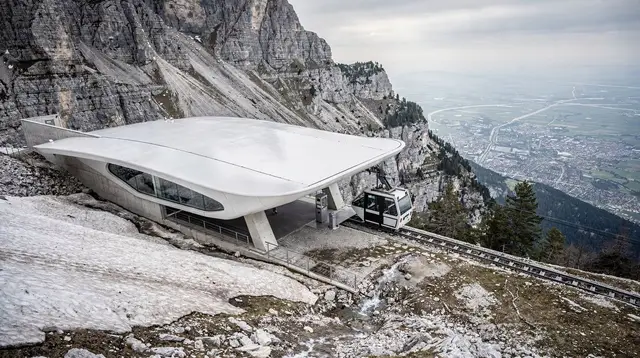
At the top of the lift system, on the Schaufeljoch ridge, sits TOP OF TYROL, a viewing platform at about 3,210 m. It is reached on the same ticket used for skiing, and it functions as both a mountain viewpoint and a natural stopping point on a ski day — a place to take off the skis for ten minutes, look out over the Zillertal Alps and the Ötztal Alps, and on a clear day pick out the higher peaks along the Italian border further south.
Because it sits on the lift network rather than requiring a separate excursion, TOP OF TYROL also draws visitors who are not skiing at all, particularly in the shoulder parts of the season when the glacier is open but the pistes below aren’t fully set. It is worth building fifteen minutes into a ski day for, but it should be thought of as a bonus on top of the skiing rather than the main reason to come up — the terrain and the lift network are why people ski here.
The season, honestly
This is the part that gets misremembered most often, so it is worth being precise. The Stubai Glacier typically opens in late September or early October and closes in late June, giving it one of the longest ski seasons of any resort accessible from Innsbruck. Within that window, conditions vary: early autumn and late spring skiing is usually limited to the upper glacier basin, with fuller terrain opening once winter snowfall builds up, generally from December.
What the Stubai Glacier does not do is stay open through the summer. It closes for a maintenance break of several weeks, usually across parts of July and August, before reopening for the following season. If you have heard that a Tyrolean glacier skis in every month of the year, that reputation belongs to Hintertux, in the Zillertal to the east — a separate valley with its own access road, not a part of the Stubai and not reachable by the same lift system.
The two are genuinely different ski areas, and mixing them up is the single most common mistake in trip planning for this part of Tyrol; see Stubai Glacier versus Hintertux for the fuller comparison if a year-round glacier day is actually what you are after.
The table below gives a rough seasonal shape. Treat the exact opening and closing dates as indicative — they shift from year to year with snowfall, and the only reliable source for a specific week is the operator’s own live snow report checked shortly before travelling.
| Period | What to expect |
|---|---|
| Late September – November | Upper glacier basin only, limited runs, quiet slopes, unreliable lower-mountain snow |
| December – March | Full lift network typically open, best coverage, part of the core Olympia SkiWorld winter |
| April – late June | Long spring skiing window with good glacier snow, warmer temperatures, fewer crowds than winter |
| July – early September | Closed for summer maintenance; the area switches to hiking and TOP OF TYROL sightseeing only |
How it fits with skiing from Innsbruck
The Stubai Glacier is one of the areas covered by the Olympia SkiWorld Innsbruck ski pass, the multi-area pass that also covers the Nordkette, Patscherkofel, Axamer Lizum, Muttereralm, Kühtai, Schlick 2000, Rangger Köpfl and Glungezer, with free ski buses laid on from the city.
That is the basis of a genuinely local pattern worth building a trip around: stay in Innsbruck, and ski a different mountain each day rather than committing to a single resort for a whole week. The Stubai Glacier’s altitude makes it the natural choice for the days when lower slopes are thin — it is usually the most snow-reliable single area in the network, particularly in early and late season.
Because so much of the terrain sits on a broad, gentle glacier plateau, it is also one of the better areas in the region for family and beginner skiing: wide blue and easy red runs served by modern lifts, with the steeper terrain concentrated on a smaller set of runs off the surrounding ridges rather than mixed in everywhere. Confirm the current ski season dates for the specific mountains you plan to combine, since not every area in the SkiWorld network opens and closes on the same calendar.
If a guided introduction to the glacier appeals more than working it out from a piste map, a short guided outing is a straightforward way to get oriented on the first run of the day — an option along the lines of a guided glacier experience with a basic skills session on the Stubai Glacier covers exactly that first-morning orientation before you head off on your own.
Getting there without a car
Driving is the most direct route, but the Stubai valley is also served by regional bus lines from Innsbruck’s main station area up through Neustift to the Mutterberg valley station, and by dedicated ski buses within the SkiWorld network during winter. Public transport takes noticeably longer than driving — plan on well over an hour each way once connections are accounted for — so many day skiers still choose to drive, share a car, or book an organised transfer that collects from central Innsbruck.
Whichever way you arrive, the last stretch is the same for everyone: a gondola from Mutterberg up to the glacier’s mid station, followed by connecting lifts to the plateau and on to the Schaufeljoch and TOP OF TYROL. Parking at Mutterberg is plentiful by Alpine standards but fills on the busiest winter Saturdays, so an early start helps regardless of how you travel.
Beyond the piste: the rest of a Stubai day
A ski day here does not have to be only skiing. The valley below the glacier is one of Tyrol’s more active corners once the lifts close for the afternoon, and it is worth knowing what else is on offer nearby even on a page that is otherwise strictly about the skiing.
Neustift and the surrounding Stubai valley run a full paragliding season in the warmer months, with tandem flights launching over the valley floor — a tandem paragliding flight over the Stubai valley or, for a version that leans into the panorama itself, a panoramic tandem paragliding flight above Neustift im Stubaital — though these run outside the winter ski window rather than alongside it.
For a slower, food-focused outing on a non-ski day in the valley, a guided hike to an Alpine hut in the Stubai Alps built around a proper hut lunch is a good match for the valley’s other identity as a serious hiking base once the snow retreats — worth filing away for a return trip in summer rather than expecting on a winter ski week.
Comparing the Stubai Glacier with other options
Innsbruck sits within reach of several genuinely different ski experiences, and the Stubai Glacier is only one of them. The Ötztal and Sölden offer another large, high-altitude area a little further west, with its own glacier sections and a more built-up resort base than Neustift.
Nordkette and Patscherkofel, both inside the city’s own boundary, are far smaller but need no drive at all. None of the three should be confused with the Stubai Glacier’s long-season reliability, and none of them matches Hintertux’s genuine year-round operation — each area in this part of Tyrol has a distinct season and character, and matching the right one to the right week of a trip matters more than picking on reputation alone.
For a longer stay based in the valley itself rather than as a day trip, a two-day Stubai valley itinerary or a full Olympia SkiWorld ski week built around Innsbruck both give a fuller sense of how the glacier sits alongside the valley’s other villages and the rest of the pass network.
Stubai Glacier skiing FAQ
Does the Stubai Glacier ski all year?
No. The Stubai Glacier runs a long season, usually from around late September or early October through to late June, but it does close for a summer maintenance break of several weeks. The Tyrolean glacier that stays open in every month of the year is Hintertux, in the Zillertal — a different valley to the east, not part of the Stubai.
How far is the Stubai Glacier from Innsbruck?
About 45 minutes by road, roughly 35-40 km via the Stubai motorway and then up through Neustift im Stubaital to the Mutterberg valley station. It is one of the closer glacier ski areas to a European city centre, which is why it is often skied as a day trip from Innsbruck rather than from a base in the valley itself.
What is the TOP OF TYROL platform?
TOP OF TYROL is the viewing platform at the Stubai Glacier’s highest lift station, the Schaufeljoch, at about 3,210 m, in Austrian Tyrol. It gives a 360-degree panorama that on a clear day takes in the Zillertal Alps, the Ötztal Alps and, further off, the main ridge of the Alps toward Italy and South Tyrol, which lie across the Brenner border. It is reachable on the same lift ticket used for skiing, and also draws non-skiing sightseers in summer.
Is the Stubai Glacier good for beginners?
Yes, in parts. The glacier plateau around the middle and upper stations has a genuinely large area of blue and easy red runs served by fast lifts, which is why ski schools use it heavily for beginner weeks even in months when lower resorts have no snow. The steeper terrain is concentrated on a smaller number of runs off the ridges, so beginners are not forced onto it.
Can you get to the Stubai Glacier by public transport?
Yes. A regional bus line runs from Innsbruck’s main station area up the Stubai valley to Neustift and on to the Mutterberg valley station, and ski buses also run within the Olympia SkiWorld network in winter. It takes longer than driving — figure on over an hour each way — so many day skiers still choose to drive or join an organised transfer.
Is the Stubai Glacier part of the Olympia SkiWorld Innsbruck pass?
It is included as one of the areas covered by the wider Olympia SkiWorld Innsbruck ski pass alongside the Nordkette, Patscherkofel, Axamer Lizum, Muttereralm, Kühtai, Schlick 2000, Rangger Köpfl and Glungezer, which is the basis of the local habit of staying in Innsbruck and skiing a different mountain each day. Single-day and glacier-only tickets are also sold separately at the valley station.
What should I check before planning a Stubai Glacier ski day?
Check the operator’s live snow report and opening dates for the specific week you are travelling, because both the opening in autumn and the closing in early summer shift from year to year with snowfall. Outside the core winter months it is worth a direct check rather than assuming the glacier is open, since a short summer maintenance closure is normal.
Skiing and snowboarding on GetYourGuide
Verified deep-linked GetYourGuide tours. Book through these links and we earn a small commission at no cost to you.
GetYourGuide does not provide a product photo for this activity — the image shows the meeting point, photographed by us.