Innsbruck in the Shoulder Season: What Actually Closes
Can you visit Innsbruck in the shoulder season (mid-April to late May, or November)?
Yes, but plan around closures: many cable cars, mountain huts and high-altitude restaurants shut for maintenance in these windows, and high trails can still hold snow into June. It is also the quietest and cheapest time to visit, so check each lift's and attraction's opening dates individually before booking anything.
Two Quiet Windows, Not One Long Off-Season
“Shoulder season” in Innsbruck is not a single lull between summer and winter. It is two separate windows, and they behave differently. The first runs roughly from mid-April to the end of May, after the ski lifts stop turning and before the high trails are reliably clear. The second is November, after the hiking season winds down and before the Christmas markets and the ski season begin. Both are genuinely quiet and genuinely cheap. Both also come with a specific, checkable list of things that will not be operating, and the honest version of this guide is the one that names them rather than hiding them behind a “visit any time” headline.
The city at 594 metres in the Inn valley is open every single day of the year — the old town, the museums, the restaurants, the trams and buses. What closes is the infrastructure that gets people up the surrounding mountains and into the huts at altitude, and a handful of attractions that use these same quiet weeks for their own maintenance. Knowing which is which is the entire point of this page.
What Actually Closes Between Mid-April and Late May
This is the region’s main annual maintenance window. Ski season has ended, snow is melting off the mid-altitude slopes, and neither the lift operators nor the hut keepers want to run a service for the small number of visitors who show up in this gap. Individual operators pick their own dates, and they change slightly year to year depending on how the winter went, so treat the table below as a pattern to expect, not a fixed calendar.
| What | Typical shoulder-season pattern | What to do about it |
|---|---|---|
| Summer-only mountain lifts | Closed until the trails clear, often into May | Check the operator’s site for the current reopening date |
| Mountain huts | Many close entirely between winter and summer service | Confirm before planning a hut-to-hut day |
| High-altitude restaurants | Follow the lifts and huts, closed with them | Build meals around the valley and old town instead |
| High trails above about 1,800-2,000 m | Can still hold snow into June | Ask locally or check a current trail report before setting out |
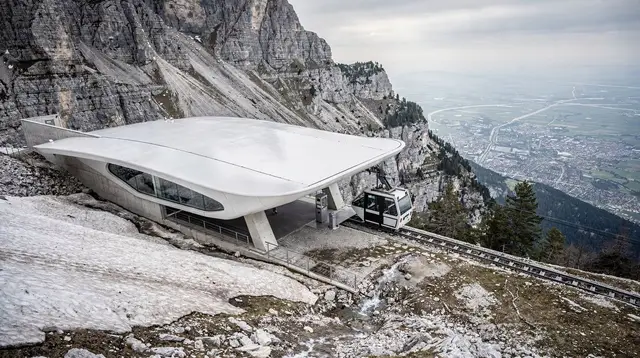
| Nordkette and Hafelekar lifts | Usually keep running with only short technical stoppages | Check current schedule, but this route is a safer bet than most |
| Stubai Glacier | Long season but not open every single day | Check the glacier’s own calendar for the exact week |
The pattern is consistent: anything that depends on snow melt or a maintenance crew is the risk. Anything that runs year-round regardless of season — the Hungerburgbahn funicular and the two lifts above it, the old town, most museums — is close to a safe bet.
What Actually Closes in November
November is the quieter and, in some ways, more predictable of the two windows, because fewer things are trying to reopen at once. The hiking season has genuinely ended, the ski season has not started, and several attractions use exactly this month for their own scheduled closures.
| What | November pattern | Note |
|---|---|---|
| Schloss Ambras | Closed for the whole month in most years | Check the castle’s visitor guide before booking a trip around it |
| Summer-only cable cars and gondolas | Paused between hiking and ski season | Confirm reopening dates before travel |
| Mountain huts | Mostly closed until winter operation | Do not plan a hut meal into a November mountain day |
| Patscherkofel and similar mid-mountain lifts | Variable — some pause, some run limited winter-prep schedules | Check the specific lift, not a general assumption |
| Christmas markets | Not yet open for most of the month | They start mid-to-late November — see when the markets open for the timing overlap |
| Old town, museums, city walks | Fully open | This is where a November trip should be centred |
The one honest caveat with November is that it briefly overlaps its own end with the start of the Christmas market season, so the very last days of the month can look and feel quite different from the first three weeks. If Christmas markets are the goal, aim for early-to-mid December instead and treat November proper as the true quiet window.
What Stays Open — And Is Actually Good Right Now
None of this is a reason to skip the city. The old town around the Goldenes Dachl and along Maria-Theresien-Straße runs on its own schedule, unaffected by mountain closures. The Hofburg, the Hofkirche, the Tyrolean Folk Art Museum, the Bergisel ski jump and Das Tirol Panorama all keep normal opening hours through both windows.
The Alpenzoo stays open, and April-May in particular is a good time to see it, since many Alpine animals are more active in cooler weather than in high summer. The city tower keeps its regular hours too, and a clear shoulder-season day gives some of the best visibility over the rooftops to the Nordkette without a summer heat haze.
Public transport does not take a season off either — IVB and VVT services run their normal timetables, so day trips to Hall in Tirol or Wattens work exactly as well in late April as in July. And the trade-off that makes the shoulder season worth considering at all is real: fewer people on Maria-Theresien-Straße, shorter queues for the funicular when it is running, and noticeably lower accommodation prices than the December markets or the peak ski weeks command.
A walking tour is a good way to use a shoulder-season day precisely because it does not depend on any lift being open. An express walk through the old town with a local guide covers the Golden Roof, the Hofburg district and Maria-Theresien-Straße in about an hour, which suits both a short spring evening and a cool November afternoon. For a slower, more detailed version of the same ground, a private walking tour of Innsbruck can be timed around whichever hours of daylight and weather the day actually offers.
How to Check Before You Book Anything
The single most useful habit for a shoulder-season trip is checking each lift and attraction individually, rather than assuming a rule that applies to the whole destination. Every cable car operator, museum and castle in the region publishes its own current opening calendar online, and these are updated for the actual year of travel — a rule of thumb from a previous season, or from a different mountain, is not a substitute. Before finalising dates, it is worth confirming:
- The exact reopening date of any specific cable car or gondola planned for the trip
- Whether the target trail’s altitude puts it above the likely snowline for that week
- Whether Schloss Ambras, if it is on the list, falls inside its November closure
- Whether a planned hut meal has a hut that is actually staffed that week
- Whether the trip’s exact dates fall before or after the Christmas market opening, if that matters
None of this takes more than a few minutes per attraction, and it is the difference between a shoulder-season trip that runs smoothly and one built on an assumption that the whole region works the way the city centre does.
A Realistic Shoulder-Season Day in Innsbruck
A day built around what is reliably open in April-May or November looks less like a mountain itinerary and more like a compact city break with valley excursions layered around it. A practical shape:
- Morning: old town on foot — the Golden Roof, the Hofkirche, Maria-Theresien-Straße — either self-guided or with an express guided walk to cover the history efficiently.
- Midday: the city tower, booked as a city tower entrance ticket, for the clearest rooftop-and-mountain view of the day, since haze is rare in these cooler months.
- Afternoon: the Alpenzoo via an Alpenzoo entrance ticket, or, if the Nordkette lifts are confirmed running that week, a short ride up for the view rather than a full high-altitude hike.
- Evening: dinner in the old town, where restaurants run their full normal schedule regardless of what is happening on the mountains above.
This kind of day works in both windows without depending on a single seasonal lift, hut or castle that might turn out to be closed the week of travel.
Who the Shoulder Season Suits
It suits a visitor who wants Innsbruck the city — its architecture, museums, old town and easy valley trips — at its cheapest and calmest, and who is happy to treat any mountain lift as a bonus to be confirmed rather than a certainty to be booked around. It does not suit a visitor whose whole plan is a multi-day high-altitude hiking programme or a specific hut-to-hut route, since those depend on infrastructure that is precisely what closes in these weeks.
For that kind of trip, the region’s dedicated summer and winter guides are the better starting point, and how many days to allow in Innsbruck is worth reading either way before setting final dates. For a season-by-season comparison across the whole year, see the best time to visit Innsbruck, and for a route that is honestly built around these quieter weeks, the shoulder-season Tyrol itinerary lays out a full trip rather than a single day.
Common Questions About Visiting Innsbruck in the Shoulder Season
Is Innsbruck open all year round as a destination?
The city itself is open every day of the year — the old town, museums, restaurants and public transport all operate normally. What is not year-round is the mountain infrastructure around it: several cable cars, mountain huts and high-altitude restaurants close for maintenance in defined windows, mainly mid-April to late May and in November.
What closes in Innsbruck between mid-April and the end of May?
This is the main annual maintenance window for cable cars and mountain huts across the region, since the ski season has ended but summer hiking has not fully begun. Individual lifts set their own dates, so some reopen in early May and others stay shut into June — always check the specific lift’s calendar rather than assuming a fixed date.
What closes in Innsbruck in November?
November is the second maintenance window, between the end of the hiking season and the start of skiing and Christmas markets. Schloss Ambras closes for the whole month in most years, several summer-only cable cars pause, and some mountain huts shut until winter opening — while the Christmas markets themselves only start in mid-to-late November.
Is the Nordkette cable car open in the shoulder season?
The Hungerburgbahn funicular and the Nordkette cable cars generally keep running with only short technical closures, since they serve both hikers and, in winter, skiers. Even so, checking the operator’s current schedule before you go is the safer habit, since maintenance days do occur.
Can I still hike in Innsbruck’s mountains in April or November?
Lower and valley-floor trails are usually fine, but high trails above roughly 1,800 to 2,000 metres can hold snow well into June and start collecting it again in November. Treat any high-altitude hike in these windows as conditional on a fresh trail report, not as a given.
Is it worth visiting Innsbruck in the shoulder season?
For visitors who want a quieter, cheaper city trip built around the old town, museums, valley walks and day trips, yes — it can be excellent. For visitors who specifically want a full mountain programme of lifts, huts and high trails, the shoulder season is the wrong choice and a summer or winter date will deliver more.
How do I check whether a specific cable car or attraction is open?
Each lift operator and attraction publishes its own current-season opening calendar online, and this is the only reliable source, since dates shift slightly year to year with the snow and the maintenance schedule. Checking the operator’s site for the exact week of travel, rather than relying on a general rule, avoids the disappointment of arriving at a closed station.
Is Schloss Ambras open in November?
No. Schloss Ambras closes for the entire month of November in most years for its own maintenance schedule, separate from the mountain lifts. If a visit to Ambras matters to a trip, it needs to be scheduled outside November and confirmed against the castle’s own calendar.
Seasonal experiences on GetYourGuide
Verified deep-linked GetYourGuide tours. Book through these links and we earn a small commission at no cost to you.
GetYourGuide does not provide a product photo for this activity — the image shows the meeting point, photographed by us.